Modi at 12: The Decisions That Redefined India’s Trajectory
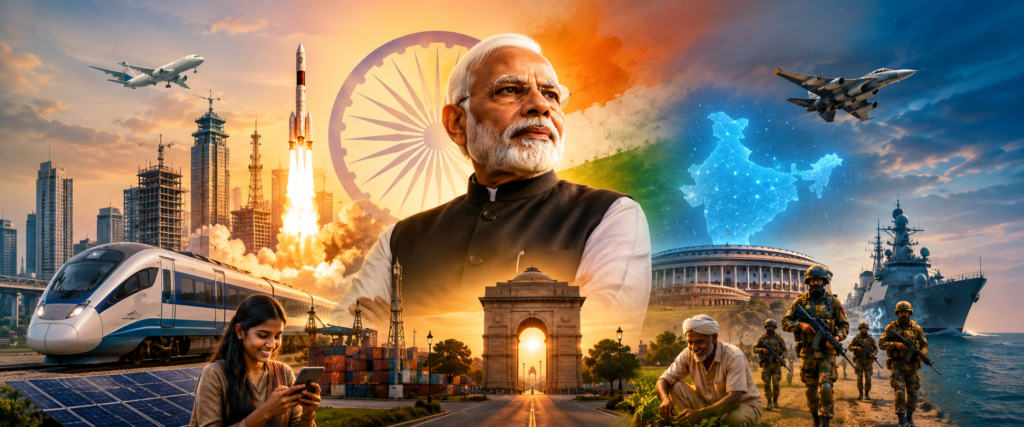
When Prime Minister Narendra Modi assumed office in 2014, India was navigating economic uncertainty, coalition pressures and administrative slowdowns. Over the next twelve years, the country underwent sweeping political, economic and strategic changes that supporters describe as one of the most consequential transformations in post-Independence India.
India has since risen from being the world’s 11th-largest economy to the fourth largest, with GDP expanding from nearly $2 trillion to over $4 trillion. The journey was shaped by a series of bold and often debated decisions that altered the country’s policy direction, governance structure and international positioning.
Majority Rule and Policy Stability
The BJP’s decisive majority victory in 2014 ended decades of coalition-era dependence at the Centre. For the first time in nearly 30 years, a single party had the numbers to govern without relying heavily on regional allies.
This political stability enabled the government to push through long-pending reforms that had stalled under coalition compulsions, including taxation changes, financial reforms and large-scale infrastructure initiatives. The stronger mandate in 2019 further strengthened the Centre’s ability to implement structural policy changes.
Demonetisation and the Push Towards Digital India
In November 2016, the government invalidated high-value ₹500 and ₹1,000 currency notes, removing most of the cash circulating in the economy overnight. The move triggered major disruptions in the short term, affecting businesses, workers and rural markets.
However, the decision also accelerated India’s shift towards digital payments and formal banking systems. Millions entered the banking network, digital transactions surged and financial technology adoption grew rapidly across urban and rural India alike.
GST and the Creation of a Unified Market
The rollout of the Goods and Services Tax (GST) in 2017 replaced multiple indirect taxes with a unified national tax system. It brought together central and state tax structures under one framework, simplifying interstate trade and logistics.
Since implementation, GST collections have steadily increased while the taxpayer base has expanded significantly. Supporters argue that the reform helped formalise businesses and created a more integrated domestic market.
Article 370 and Kashmir Reorganisation
In August 2019, the government revoked Article 370, ending the special constitutional status of Jammu and Kashmir and reorganising the region into Union Territories.
The move drew both support and criticism nationally and internationally. The Centre has since highlighted reductions in local militancy, increased investments and the return of electoral processes as indicators of progress. Critics, however, continue to debate the political and democratic implications of the decision.
India’s Evolving Security Doctrine
India’s security posture also underwent a visible shift during the Modi years. Following major terror attacks, the government adopted a more aggressive counter-terror response strategy.
Operation Sindoor in 2025 marked a major moment in this approach, with Indian forces carrying out strikes on terror infrastructure across the border following the Pahalgam attack. The operation reflected what the government described as a “new normal” in India’s security doctrine.
G20 Presidency and Global Diplomacy
India’s presidency of the G20 became a major diplomatic milestone. One of its most notable achievements was securing permanent membership for the African Union in the grouping.
India also promoted Digital Public Infrastructure, supply-chain cooperation and connectivity projects while positioning itself as a bridge between developed and developing nations.
Voice of the Global South
Through initiatives like the Voice of the Global South Summit, India strengthened engagement with developing nations across Asia, Africa and Latin America.
The government pushed issues such as climate finance, food security, debt relief and digital inclusion onto global forums. India’s digital payment and identity platforms also began expanding internationally through partnerships with multiple countries.
Neighbourhood First and Act East
The Modi government placed renewed emphasis on regional diplomacy through its “Neighbourhood First” and “Act East” policies.
Infrastructure and connectivity projects involving Bangladesh, Myanmar and Southeast Asia aimed to strengthen trade routes and strategic influence. Though some initiatives faced delays due to regional instability, the broader strategy reflected India’s effort to deepen regional integration.
The Rise of India Stack
India’s digital ecosystem expanded dramatically through platforms like Aadhaar, UPI and DigiLocker.
UPI emerged as one of the world’s largest digital payment systems, while Aadhaar became the backbone of welfare delivery and identity verification. Direct Benefit Transfers also increased significantly, helping the government route subsidies directly to beneficiaries.
The India Stack model is now being studied and adopted in several countries worldwide.
Defence Manufacturing and Self-Reliance
The government’s push for defence indigenisation under the Atmanirbhar Bharat initiative transformed India’s defence production landscape.
Exports grew sharply while indigenous platforms such as the Tejas fighter jet, Akash missile system, BrahMos missile and INS Vikrant gained prominence. The private sector’s role in defence manufacturing also expanded during this period.
India’s Nuclear Energy Push
Recent reforms in the nuclear sector opened the door for private participation and eased long-standing regulatory barriers that had slowed expansion.
India’s Prototype Fast Breeder Reactor at Kalpakkam achieving criticality in 2026 was viewed as a major milestone in the country’s long-term nuclear ambitions. The government aims to significantly increase nuclear power generation capacity over the coming decades.
India’s New Global Position
Taken together, these decisions reshaped how India is viewed globally. From economic reforms and digital governance to strategic autonomy and defence capability, the country has increasingly projected itself as a leading power rather than a balancing one.
Challenges remain — including employment generation, regional inequalities and infrastructure demands — but the last twelve years marked a decisive shift in India’s political and economic trajectory. Whether viewed through the lens of governance, diplomacy or technology, the Modi era has undeniably altered the direction of the Indian state.
Originally published on 24×7-news.com.