Delhi Airport Plans India’s First Driverless Air Train Network
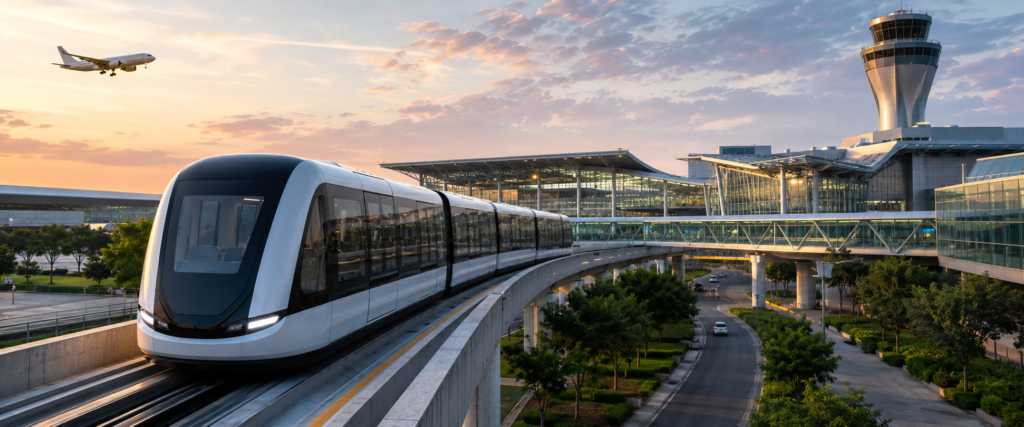
Indira Gandhi International Airport is preparing to launch India’s first fully driverless Air Train system as part of a major upgrade to passenger transport infrastructure within the airport campus.
The proposed Automated People Mover (APM) project is expected to cost around ₹3,500 crore and will connect key zones including Terminal 1, Terminal 2, Terminal 3, Aerocity and Cargo City through a dedicated 7.7-kilometre transit corridor.
Dedicated Transit Corridor Across Airport Campus
According to the project blueprint, the Air Train network will operate on a combination of elevated and ground-level tracks designed to improve movement across the airport complex.
The planned route will connect:
- Terminal 1 (T1)
- Terminal 2 (T2)
- Terminal 3 (T3)
- Aerocity
- Cargo City
Airport officials believe the system will offer quicker and more efficient transfers for both travellers and airport employees while reducing dependence on shuttle buses operating inside the airport.
Delhi Airport To Finance Entire Project
The project is being developed by Delhi International Airport Limited, which is expected to fully fund the construction and implementation of the Air Train system.
Current estimates place the project cost between ₹3,000 crore and ₹4,000 crore depending on final execution plans. Construction is expected to take approximately 30 months once work begins.
If timelines remain on track, the driverless transit system could become operational between late 2027 and 2029.
Faster Terminal Transfers Expected
Airport authorities say the Air Train will significantly improve inter-terminal connectivity and help ease traffic congestion caused by internal shuttle bus services.
Transit passengers moving between terminals are likely to be allowed free access to the service, while visitors and non-passengers may be charged a nominal fare.
Officials also expect the project to improve overall passenger convenience and contribute positively to the airport’s Airport Service Quality (ASQ) ratings.
Electric System Designed To Reduce Emissions
The Air Train will run as an electric rail-guided transit network operating on a completely dedicated corridor separated from regular vehicular traffic.
By replacing a large share of diesel-powered airport shuttle buses, authorities believe the system could help lower congestion and reduce carbon emissions within the airport campus over time.
Similar automated people mover systems are already functioning at major international airports including those in Dubai, Singapore and Heathrow Airport.
Elevated And Ground-Level Tracks Planned
Of the total 7.7-km route, around 5.7 km is expected to run on elevated tracks, while the remaining 2 km will be developed at ground level.
The hybrid design is intended to improve integration with existing airport infrastructure while minimising operational disruptions during construction.
Passenger Capacity To Increase Over Time
The Automated People Mover system is initially being designed to handle approximately 40,000 to 50,000 passengers daily.
Airport planners expect that capacity to eventually rise to between 80,000 and 90,000 passengers per day by increasing train frequency as demand grows in the future.
Unlike shuttle buses that share roads with airport traffic, the Air Train will operate on a fully dedicated corridor, allowing for faster and more predictable travel times.
Concerns Over Construction Impact
Despite the long-term environmental benefits being highlighted by authorities, concerns have also been raised regarding the construction phase of the project.
Previous expansion work at the airport, including the development of Terminal 3, reportedly led to displacement issues in nearby settlements. Environmental experts have also warned that excavation work and elevated construction activities could temporarily worsen air pollution levels in surrounding areas of Delhi.
Dust emissions during the expected 30-month construction period may increase PM10 and PM2.5 pollution levels, potentially affecting construction workers, nearby residents and low-income communities most exposed to outdoor conditions.
What Is The Air Train Project?
The proposed Air Train is a fully automated driverless transit network designed to improve connectivity across Delhi airport’s major terminals and operational hubs.
Once completed, the system will link T1, T2, T3, Aerocity and Cargo City through a dedicated 7.7-km route and is expected to become operational sometime between 2027 and 2029.
Originally published on 24×7-news.com.