
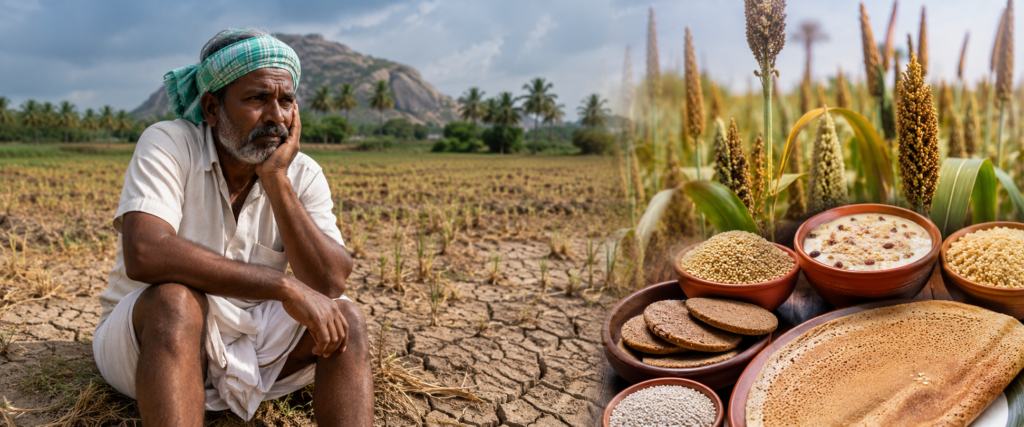
Millet-based foods may be gaining popularity in Tamil Nadu’s cities, but many farmers across the state are steadily abandoning millet cultivation due to weak market support, unstable prices and the absence of assured procurement systems.
Agricultural experts say farmers prefer crops such as paddy and maize because they offer guaranteed buyers and stronger financial security, while millets continue to depend heavily on uncertain private markets.
Farmers like K Mohan from the Nilgiris stopped growing traditional millet varieties such as ragi and samai years ago after facing difficulties in selling their produce. He eventually shifted to tea cultivation, which offered better and more stable returns.
Data from Tamil Nadu Agricultural University (TNAU) for 2024-25 shows that minor millets are cultivated on only 1.34 lakh hectares in the state, compared to over 21 lakh hectares under paddy cultivation.
However, some farmers continue to sustain millet farming successfully. In Virudhunagar district, farmer I Packiaraj cultivates traditional millet varieties across 40 acres under a joint family farming model. He says millet farming requires lower investment, survives irregular rainfall and becomes profitable when supported by institutional buyers.
Packiaraj credits government assistance and seed support from TNAU since 2019 for improving production and ensuring stable procurement of his produce. A large portion of his harvest is now purchased by the agriculture department for seed distribution purposes.
Experts believe the major obstacle for millet cultivation is the lack of a complete support ecosystem. While public interest in healthy and traditional foods is increasing, farmers often struggle because there are not enough processing units, storage facilities or large-scale buyers.
Scientists from TNAU point out that maize cultivation expanded rapidly in Tamil Nadu because poultry industries created assured demand. Millets, despite being climate-resilient crops suitable for drought-prone regions, have not received similar market backing.
Another concern raised by researchers is the absence of state-specific minimum support price (MSP) systems for several millet varieties. Crops such as samai, thinai and varagu remain outside effective procurement networks, leaving farmers vulnerable to fluctuating market prices.
Agricultural experts say the revival of millet cultivation requires strong policy support from farm to market. This includes assured procurement, crop insurance, better processing infrastructure, quality seeds and region-specific farming strategies.
In drought-prone districts such as Pudukottai, farmer producer organisations (FPOs) are showing how structured support can revive millet farming. Local FPOs now procure millet crops directly from farmers, process them into value-added food products and supply them across India and international markets. Procurement in the region has reportedly increased by 30% over the last five years.
Experts say awareness campaigns and the International Year of Millets in 2023 helped boost consumption, but long-term revival will depend on whether governments can create a reliable procurement ecosystem similar to the one supporting rice cultivation.
Originally published on 24×7-news.com.