
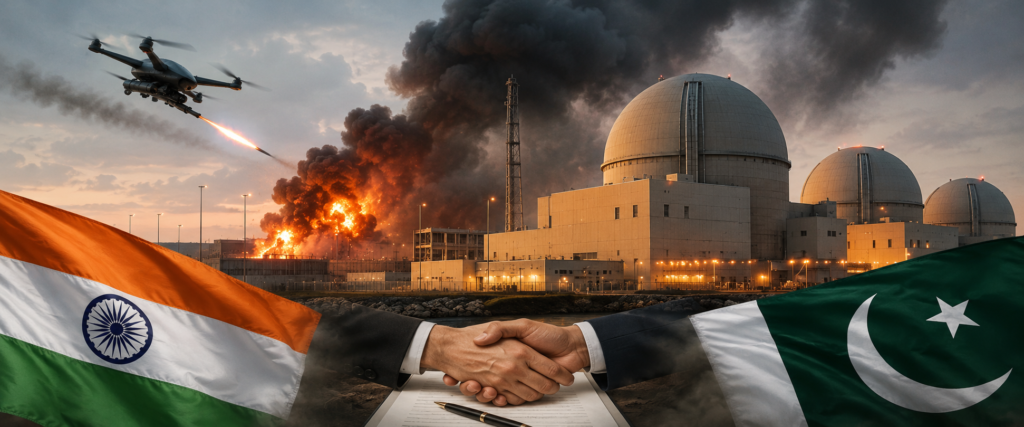
The recent drone strike targeting the Barakah Nuclear Energy Plant in the United Arab Emirates has renewed global concerns about the safety and vulnerability of nuclear facilities during armed conflicts. The Barakah plant, located in Abu Dhabi’s Al Dhafra region, is currently the only operational nuclear power station in the Arab world and plays a major role in the UAE’s energy infrastructure.
According to officials, the drone attack struck a generator unit located outside the plant’s main security perimeter, triggering a large fire and sending thick smoke into the sky. Authorities quickly confirmed that the reactors remain secure and that there has been no radioactive leakage from the facility.
India strongly condemned the attack, describing it as a dangerous escalation in regional tensions. In a statement, the Ministry of External Affairs said such actions are unacceptable and urged all sides to return to diplomacy and restraint.
The Barakah facility supplies nearly 27 percent of the UAE’s electricity needs, making it a critical national asset. Experts warn that attacks on nuclear infrastructure can have catastrophic humanitarian and environmental consequences, even if the reactor core itself remains protected.
The International Campaign to Abolish Nuclear Weapons (ICAN), recipient of the 2017 Nobel Peace Prize, has repeatedly highlighted the risks associated with attacks on auxiliary nuclear systems. While modern reactors are protected by reinforced steel and concrete containment structures, facilities such as cooling systems and spent fuel storage pools remain vulnerable during military strikes.
Researchers note that spent fuel pools can become extremely dangerous if cooling systems fail. A fire involving cesium-137 or other radioactive materials could potentially cause damage exceeding past nuclear disasters such as Chernobyl or Fukushima, leading to widespread evacuations and long-term radiation exposure.
International humanitarian law provides specific protections to nuclear facilities under Additional Protocol I of the Geneva Conventions. However, exceptions exist if such sites are used for military operations or nuclear weapons development.
The attack also comes amid rising instability in West Asia. The UAE has reportedly faced hundreds of missile and drone attacks during the ongoing regional conflict, with defence systems intercepting large numbers of ballistic missiles, cruise missiles, and drones.
The incident has also drawn attention to India and Pakistan’s long-standing nuclear safety arrangement. In 1988, both countries signed the Agreement on the Prohibition of Attack Against Nuclear Installations and Facilities, committing not to target each other’s nuclear sites during conflicts.
Under the agreement, India and Pakistan exchange updated lists and coordinates of their nuclear facilities every year. The arrangement includes nuclear power plants, uranium enrichment centres, research reactors, radioactive storage sites, and reprocessing units. The two nations recently completed 35 years of uninterrupted compliance with the agreement, which officially came into effect in 1991.
The Barakah incident serves as another reminder of the growing risks surrounding critical energy infrastructure in modern warfare and the urgent need for stronger international safeguards to protect nuclear facilities worldwide.
Originally published on 24×7-news.com.