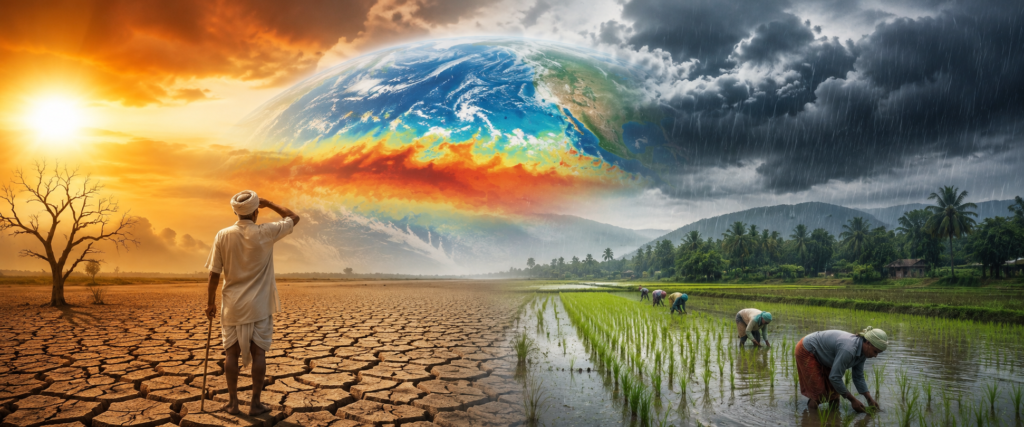
As extreme heatwaves continue to sweep across India, weather experts are closely monitoring a developing El Nino pattern in the Pacific Ocean that could significantly influence the country’s 2026 southwest monsoon season.
The southwest monsoon, which delivers nearly 70% of India’s annual rainfall between June and September, is critical for agriculture, water storage, and the rural economy. Meteorologists warn that shifting ocean conditions may create uncertainty in rainfall distribution this year, though experts say it is still too early to predict a severe “Super El Nino” event.
El Nino is part of the El Nino-Southern Oscillation (ENSO), a large-scale climate system caused by abnormal warming of sea surface temperatures in the central and eastern Pacific Ocean. This warming weakens atmospheric circulation patterns and often reduces monsoon strength over India.
According to climate experts, El Nino events do not always produce identical outcomes. Some years have witnessed drought-like conditions, while others have surprisingly delivered near-normal rainfall. Forecasters say the evolving event is currently transitioning from neutral ENSO conditions and may intensify over the coming months.
Meteorologist GP Sharma of Skymet Weather noted that India generally experiences weaker monsoon winds and below-normal rainfall during El Nino years, although consecutive strong events are uncommon and the second year is often less severe.
Scientists are also tracking the Indian Ocean Dipole (IOD), another climate indicator that can influence the monsoon. A positive IOD phase, which reflects warmer waters in the western Indian Ocean, has historically helped offset some of El Nino’s drying effects on India. Current models suggest the IOD may turn positive later in the monsoon season, potentially offering partial relief.
Historical data shows El Nino has frequently disrupted India’s monsoon. Between 1951 and 2022, nearly 60% of El Nino years recorded below-average rainfall. However, there have also been notable exceptions, including the strong 1997-98 El Nino period, when India still received above-average rainfall due to supportive ocean conditions.
Experts also caution that climate change is amplifying weather extremes globally. Earth System Scientist Raghu Murtugudde said global warming is intensifying the effects of El Nino, contributing to more severe heatwaves and increasingly unpredictable rainfall patterns.
He stressed that uneven rainfall distribution could pose a bigger challenge than the overall monsoon deficit itself, especially for agriculture and food supply chains. Pre-monsoon rains have already caused crop damage in several regions, adding to concerns over rural livelihoods and inflationary pressures.
The India Meteorological Department and international forecasting agencies are using advanced climate models to monitor ocean temperatures, atmospheric conditions, and rainfall trends. Authorities are expected to focus on drought preparedness, water conservation, crop planning, and heat action measures to reduce the potential impact.
While experts say there is no reason for panic yet, the coming weeks will be crucial in determining whether the developing El Nino weakens, intensifies, or takes an unexpected turn. For millions of Indians dependent on seasonal rains, the 2026 monsoon remains a season of both uncertainty and hope.
Originally published on 24×7-news.com.