
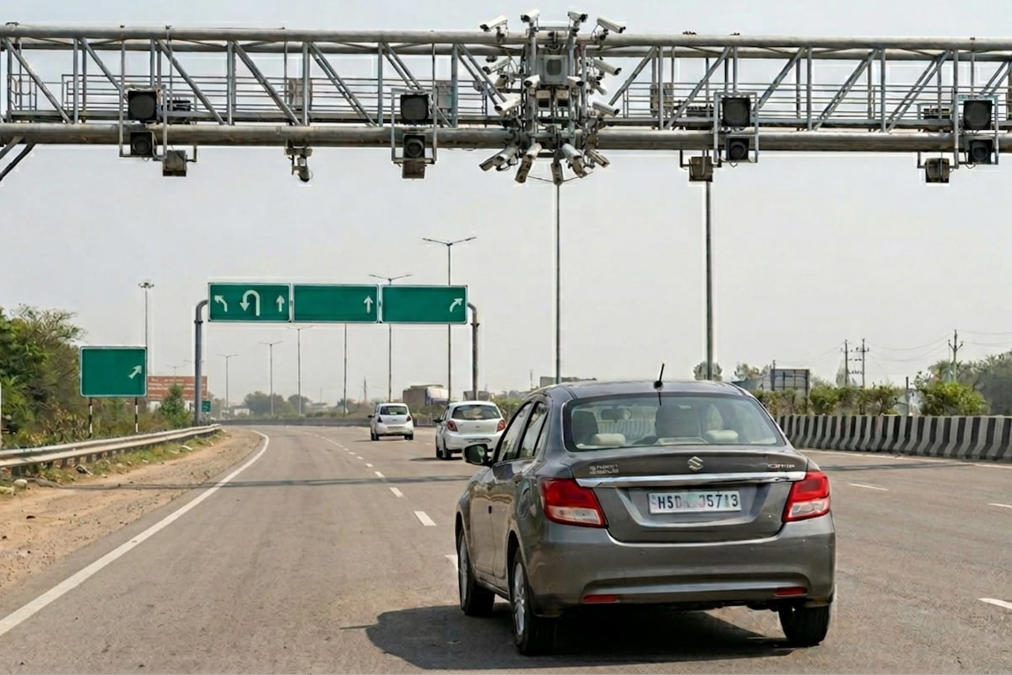
India’s newly introduced barrier-less toll collection system is already facing enforcement challenges as some commuters attempt to bypass toll payments through illegal methods. The National Highways Authority of India (NHAI) recently launched Delhi’s first barrier-free toll plaza on the Urban Extension Road-II (UER-II) corridor at the Mundka-Bakkarwala stretch, aiming to make highway travel faster and smoother without vehicles stopping at toll booths.
The advanced tolling setup operates through a Multi-Lane Free Flow (MLFF) system that uses AI-powered cameras, automatic number plate recognition (ANPR) technology and RFID-based FASTag scanning. Vehicles passing through the toll corridor are automatically identified, and the toll amount is deducted directly from the FASTag wallet linked to the vehicle.
However, officials have identified several loopholes being exploited by users to avoid payments. According to reports, some vehicle owners are tampering with High Security Registration Plates (HSRP) by partially covering or modifying them, making it difficult for cameras to accurately detect registration numbers. Non-standard number plates are also creating problems for the system.
Authorities have also observed that a small number of vehicles continue to travel without properly installed FASTags, preventing automatic toll deduction. While such cases reportedly account for less than one percent of traffic, NHAI believes stronger enforcement measures are required to ensure smooth functioning of the system.
In addition to toll evasion, similar tactics are reportedly being used to avoid automated traffic surveillance and speed cameras. Some offenders use reflective coatings, modified fonts, or illegal number plate-flipping mechanisms to confuse ANPR systems and temporarily escape detection.
The government sees barrier-less tolling as a major step towards modernising India’s highway infrastructure by reducing congestion, cutting fuel consumption and improving travel efficiency. However, authorities may now have to tighten regulations and strengthen monitoring systems to prevent misuse and ensure effective implementation of the technology-driven toll network.
Originally published on 24×7-news.com.