
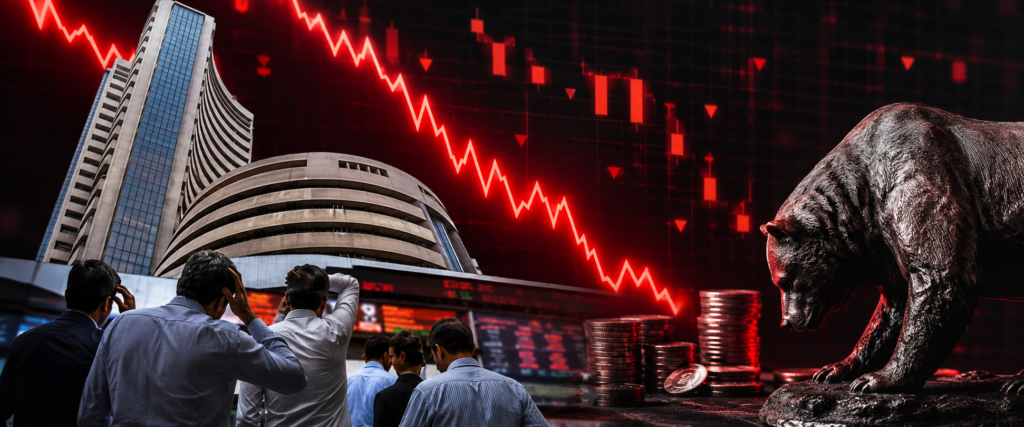
The Indian stock market has come under intense pressure over the past four trading sessions, with investors losing nearly ₹11 lakh crore in market value amid rising global uncertainty and weak investor sentiment.
Benchmark indices BSE Sensex and Nifty 50 declined sharply during Tuesday’s session, extending their losing streak to four consecutive days. During this period, both indices have fallen around 3%, while the total market capitalisation of BSE-listed companies dropped from approximately ₹473 lakh crore to ₹462 lakh crore.
Market experts believe a combination of geopolitical tensions, rising crude oil prices, foreign capital outflows, rupee weakness and fading expectations of monetary easing are weighing heavily on investor confidence.
The escalating conflict in the Middle East, particularly tensions involving the US and Iran, has added to fears of prolonged volatility in global markets. Concerns over energy prices and possible disruptions to oil supply chains are also impacting emerging markets like India.
Analysts say the market remains technically weak after the Nifty slipped below the important 23,600 level. The next major support zone is seen near 23,500, and a further breakdown could push the index closer to 23,100 levels.
Market strategists note that investor uncertainty has increased significantly as global developments remain unpredictable. Statements from US President Donald Trump regarding stalled negotiations with Iran have further intensified concerns over geopolitical stability.
Amid the uncertainty, some investors are debating whether it is safer to move into cash positions, especially after reports suggested that Berkshire Hathaway, led by legendary investor Warren Buffett, is holding record cash reserves exceeding $397 billion.
However, market experts believe that completely exiting the market may not be the best strategy for long-term investors. While broader indices may remain volatile, analysts point out that several quality stocks are now available at more attractive valuations following the recent correction.
According to market observers, the current decline may still fit within a broader “buy-on-dips” framework for long-term investors, though the depth of the correction remains uncertain.
Experts also suggest that investors adopt a balanced approach instead of moving entirely to cash. Defensive sectors such as pharma, healthcare and select FMCG companies are still showing relative strength, while crude oil-sensitive sectors like banking and IT may remain under pressure if geopolitical tensions continue.
Analysts believe the direction of the market in the coming weeks will largely depend on developments in the Middle East and the movement of global crude oil prices.
Originally published on 24×7-news.com.