A single number in the newly announced India–US trade understanding has triggered an outsized reaction across the border: 18%.
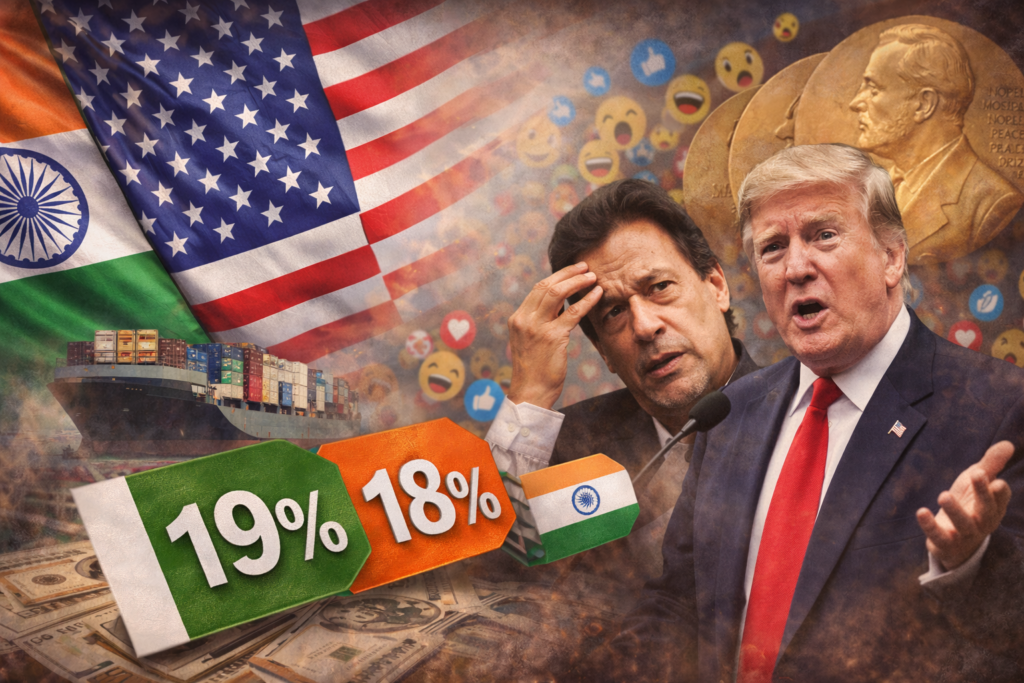
When Donald Trump announced that tariffs on Indian exports to the US would be reduced to 18%, the contrast was immediate and uncomfortable for Pakistan, which continues to face a 19% tariff rate. The difference may appear marginal, but the symbolism has proved seismic.
Across Pakistani social media, the reaction was swift and visceral. Sarcasm, memes, and self-directed anger reflected a broader sense of geopolitical disillusionment. The response was not so much about trade math as about status—about where Pakistan believed it stood with Washington, and where it has now realised it does not.
For months, Islamabad had invested heavily in cultivating goodwill with Trump. Pakistan publicly praised him, nominated him multiple times for the Nobel Peace Prize, joined his so-called “Board of Peace,” and offered cooperation on everything from minerals to regional diplomacy. Many in Pakistan believed this effort had restored the country’s position as a key US partner.
That belief unravelled with Trump’s announcement.
India, which had maintained a visibly more distant and transactional posture towards Trump, emerged with better tariff terms. The contrast fuelled a sharp reassessment within Pakistan’s elite and online discourse: proximity to power had been mistaken for influence.
The episode also highlighted a deeper misreading. Trump’s occasional public irritability with India had been interpreted in Islamabad as a weakening of India–US ties. In reality, New Delhi was exercising strategic restraint—avoiding personalised diplomacy while protecting long-term leverage.
That approach was evident during earlier tariff tensions, when Indian Prime Minister Narendra Modi reportedly declined multiple calls from Trump at the height of negotiations. US officials later attempted to frame the trade delay as a failure of access, a claim India firmly rejected.
India’s External Affairs Ministry clarified that Modi and Trump had spoken multiple times in 2025 and that negotiations stalled not due to communication gaps, but because New Delhi refused to reduce complex trade talks to personal theatrics.
The final rupture reportedly came during a June phone call when Trump claimed credit for defusing India–Pakistan military tensions. India pushed back, asserting that the situation had been managed bilaterally without US mediation.
Against that backdrop, the trade outcome delivered a blunt message. India did not secure better terms by courting Trump—it did so by signalling that it had alternatives.
Those alternatives have multiplied rapidly. In the past year alone, India has concluded trade agreements with the European Union, the United Kingdom, Oman, New Zealand, and now the United States. It has diversified its economic partnerships, reduced dependence on Washington, and positioned itself as a resilient middle power in a fragmented global order.
For Pakistan, the episode has landed as a moment of reckoning. The tariff gap is small. The geopolitical lesson is not.
Praise, performative loyalty, and symbolic gestures, the reaction suggests, do not automatically translate into leverage—especially when the underlying balance of power is unequal. That uncomfortable realisation, more than any percentage point, explains why the India–US trade announcement has struck such a nerve in Islamabad.
Originally published on 24×7-news.com.