
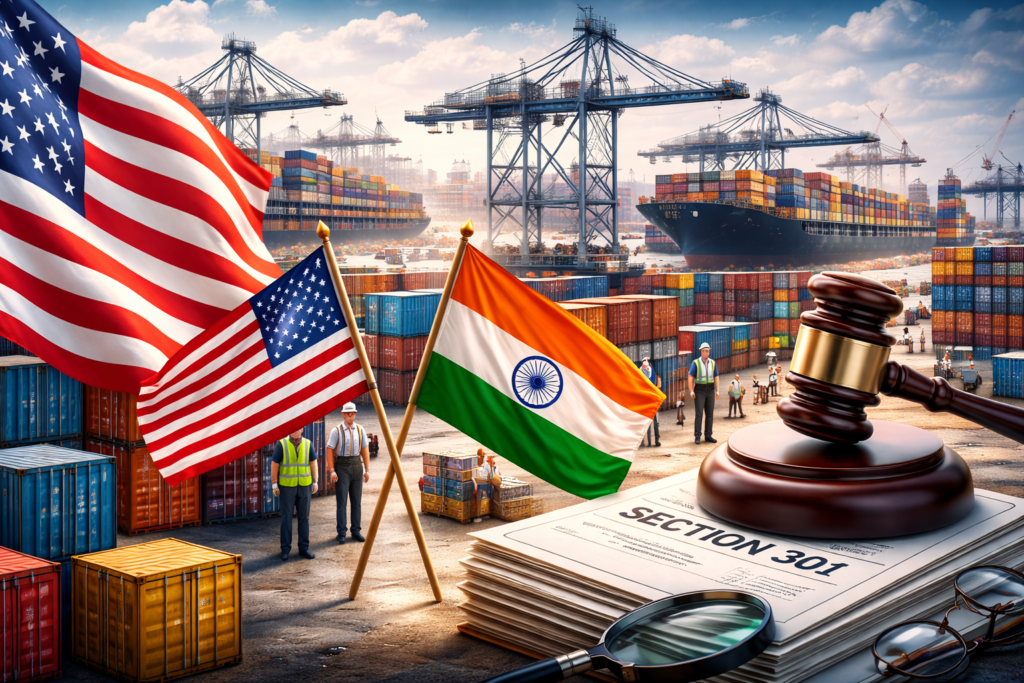
Washington: The United States has initiated a new round of trade investigations targeting sixteen major economies, including India, signalling a significant shift in Washington’s trade strategy after the collapse of former President Donald Trump’s tariff framework.
On March 11, 2026, the Office of the United States Trade Representative (USTR) launched investigations under Section 301 of the Trade Act, examining the trade policies and industrial practices of several countries.
The economies included in the probe are China, the European Union, Singapore, Switzerland, Norway, Indonesia, Malaysia, Cambodia, Thailand, South Korea, Vietnam, Taiwan, Bangladesh, Mexico, Japan, and India.
The investigations will cover a wide range of sectors including steel, aluminium, automobiles, batteries, electronics, semiconductors, chemicals, machinery and solar energy equipment.
Tariff Strategy Faces Setback
According to a report by the Global Trade Research Initiative (GTRI), the investigations come after the US Supreme Court ruled that Trump’s reciprocal tariffs were illegal, effectively dismantling the previous tariff-based trade strategy.
GTRI founder Ajay Srivastava noted that the renewed use of Section 301 indicates that Washington is transitioning to a new approach to maintain leverage in trade negotiations.
With its earlier tariff strategy curtailed by the court, the US government is now turning to targeted investigations and trade actions against specific sectors and countries.
Following the ruling, the United States quickly introduced a new measure by imposing a 10% universal tariff under Section 122 of the Trade Act of 1974, replacing the earlier system of reciprocal tariffs.
However, the shift created complications because several countries had already negotiated tariff arrangements with Washington under the previous framework.
For example:
- European Union, Japan and South Korea had agreed to tariffs of about 15%
- Vietnam and Taiwan had accepted tariffs near 20%
- Indonesia and Thailand negotiated duties around 19%
With the introduction of a uniform 10% tariff, these earlier negotiated agreements effectively lost their advantage, prompting some countries to reconsider the value of their trade deals with the United States.
Implications for India
India is among the economies currently engaged in ongoing trade discussions with the United States.
On February 6, 2026, India and the US issued a joint statement outlining steps to deepen economic cooperation. Under this understanding, India agreed to:
- Reduce tariffs on certain imported goods
- Consider purchasing over $500 billion worth of US products over the next five years
- Ease certain digital regulations affecting American technology companies
- Address specific regulatory barriers impacting US exports
However, the latest US investigation highlights several sectors in India where Washington believes there may be excess production capacity or export surpluses.
These sectors include:
- Solar modules
- Petrochemicals
- Steel
- Textiles
- Healthcare products
- Construction materials
- Automotive manufacturing
According to the US notification, India’s solar module manufacturing capacity is nearly three times its domestic demand, suggesting that large volumes of production could be directed toward export markets.
The US has also expressed concern about rapidly expanding industrial capacity in petrochemicals and steel, which it believes could influence global market competition.
Section 301 Remains Key Trade Tool
Despite the legal setback to Trump’s tariff policy, Section 301 investigations remain a powerful instrument in US trade enforcement.
However, they operate under stricter legal conditions and require clear evidence that foreign trade practices harm US industries.
Washington may also explore using Section 232 of the Trade Expansion Act of 1962, which allows the government to impose tariffs on imports that are deemed a threat to national security. This mechanism has previously been used to impose duties on steel and aluminium imports.
How the Investigation Will Proceed
The investigation process under Section 301 involves multiple stages of review and public consultation.
Key dates include:
- March 17, 2026: Public dockets open for written comments
- April 15, 2026: Deadline for written submissions and hearing requests
- May 5–8, 2026: Public hearings to be held at the US International Trade Commission in Washington
- Seven days after hearings: Deadline for rebuttal submissions
After evaluating submissions and consulting with the governments involved, the USTR will determine whether the identified practices warrant retaliatory trade actions, which could include additional tariffs, import restrictions, or other trade measures.
Originally published on 24×7-news.com.