
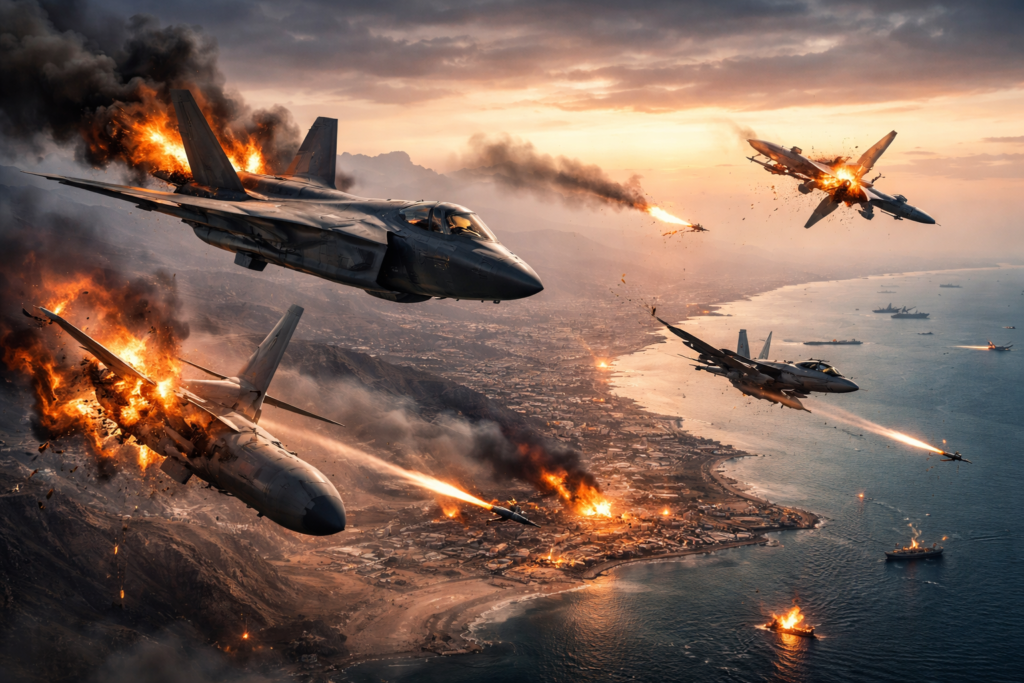
The ongoing conflict between the United States and Iran has entered a critical phase, with new reports indicating significant losses for the US military. According to sources cited by Bloomberg, at least 16 American aircraft have been lost within the first three weeks of operations in the Middle East.
The losses include a mix of manned aircraft and unmanned systems, highlighting the intensity and risks of the current air campaign. Among the incidents, a fifth-generation F-35 fighter jet was reportedly hit during operations and forced to make an emergency landing at a US base in the region. While the pilot survived and is stable, officials have not fully confirmed whether Iranian fire was responsible.
Casualties and Major Incidents
The conflict has also resulted in human casualties. Since the beginning of operations on February 28, thirteen US service members have lost their lives. Six personnel were killed in a mid-air incident involving a KC-135 refuelling tanker, while seven others died in Iranian attacks.
Additionally, around 200 military personnel have been injured across multiple Middle Eastern locations. Most of the wounded have reportedly returned to duty, reflecting the scale and tempo of ongoing operations.
One of the most severe incidents involved the destruction of a KC-135 tanker during a mid-air operation, resulting in the death of all six crew members onboard. In another case, three F-15 fighter jets were mistakenly shot down due to friendly fire over Kuwait. Furthermore, five KC-135 aircraft sustained damage following an Iranian ballistic missile strike on a US base in Saudi Arabia.
Drone Losses Increase
Unmanned aerial vehicles have also taken heavy losses. Out of the total aircraft losses, ten were drones, including at least nine MQ-9 Reaper drones shot down by Iranian air defence systems. Another drone was destroyed during a missile strike at a Jordanian airfield, while a few others were lost due to operational accidents.
Despite being designed for high-risk missions and considered expendable compared to crewed aircraft, the scale of drone losses underscores the effectiveness of Iran’s air defence network.
Limited Air Superiority
Despite initial efforts to weaken Iran’s air defence capabilities, the US has not been able to establish complete control over Iranian airspace. Military officials have acknowledged that only partial and localized air superiority has been achieved.
Iran’s remaining air defence systems continue to challenge US operations, particularly in strategically vital areas such as the Strait of Hormuz, where securing safe passage remains a major concern.
High-Intensity Operations Under Pressure
Experts suggest that the high number of missions being flown daily is a key factor behind the rising losses. Analysts point out that the current operational tempo may even exceed early phases of previous conflicts like the Gulf War.
While accidents such as mid-air collisions are not uncommon in large-scale military operations, the combination of intense activity and active enemy resistance is contributing to the growing toll.
As the conflict enters its third week, Iran has continued retaliatory strikes across the region, targeting key infrastructure in countries such as Qatar and Saudi Arabia. Although US operations remain ongoing, the mounting losses highlight the increasing cost and complexity of sustaining a prolonged, high-intensity air campaign.
Originally published on 24×7-news.com.