
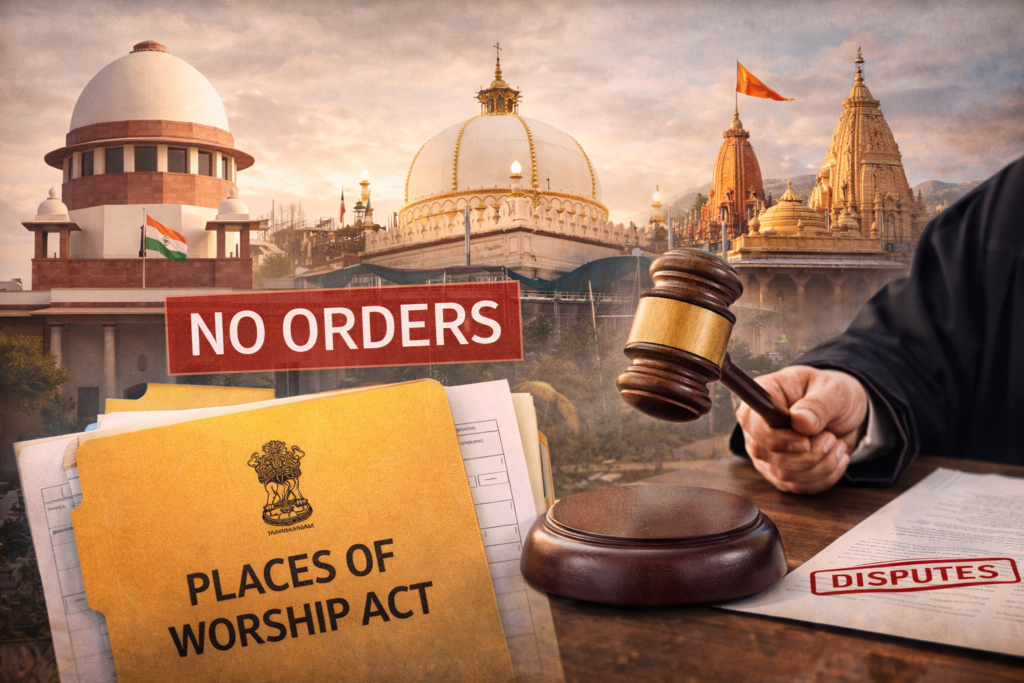
The Supreme Court has reiterated that no court in the country can pass effective interim or final orders in pending disputes concerning the religious character of structures until it decides on the constitutional validity of the Places of Worship Act, 1991.
A three-judge bench led by Chief Justice Surya Kant reaffirmed its earlier order dated December 12, 2024, while disposing of an application related to the Ajmer Sharif Dargah dispute. The bench made it clear that its previous directive is binding on all courts.
The application was filed by Imran A, who sought a stay on proceedings before an Ajmer civil court hearing petitions linked to the Ajmer Sharif Dargah. He argued that there was an apprehension that an order might soon be passed and requested strict enforcement of the Supreme Court’s December 12 directive.
However, the bench declined to intervene at this stage, noting that no order had yet been passed by the lower court. The Chief Justice observed that the apex court would examine any order if and when it is issued, particularly if it appears to contravene the Supreme Court’s directions.
Justice Joymalya Bagchi, part of the bench, clarified that while fresh suits may be instituted, they cannot proceed further until the Supreme Court decides on the constitutional challenge to the Act.
Pending Constitutional Challenge
The court is currently hearing a batch of nearly a dozen petitions challenging the constitutional validity of the Places of Worship Act, a matter that has remained pending for over five years. Despite multiple hearings, the Centre has yet to file its counter-affidavit outlining its stand on the law.
The bench also declined to fix a date for hearing an application seeking to lift the stay on proceedings in Mandir-Masjid disputes, which include high-profile cases such as Gyanvapi, Mathura, Krishna Janmabhoomi and Sambhal.
In its December 12, 2024 order, the Supreme Court had directed that although fresh suits may be filed, they should not be registered or proceeded with until further orders. It also prohibited courts from passing interim or final orders, including those directing surveys, in ongoing disputes.
What Is the Places of Worship Act?
The Places of Worship Act, 1991 mandates that the religious character of a place of worship must remain as it existed on August 15, 1947. The law is central to several ongoing disputes across the country involving religious sites.
In the case of Ajmer Sharif Dargah in Rajasthan, petitions have been filed claiming the site was originally a Hindu temple dedicated to Lord Shiva. Hindu groups have sought an Archaeological Survey of India (ASI) investigation and the right to worship at the site. The Ajmer court had admitted these petitions, prompting concerns over possible interim orders.
For now, the Supreme Court has made it clear that no substantive judicial action can proceed in such matters until it settles the question of the Act’s constitutional validity.
Originally published on 24×7-news.com.