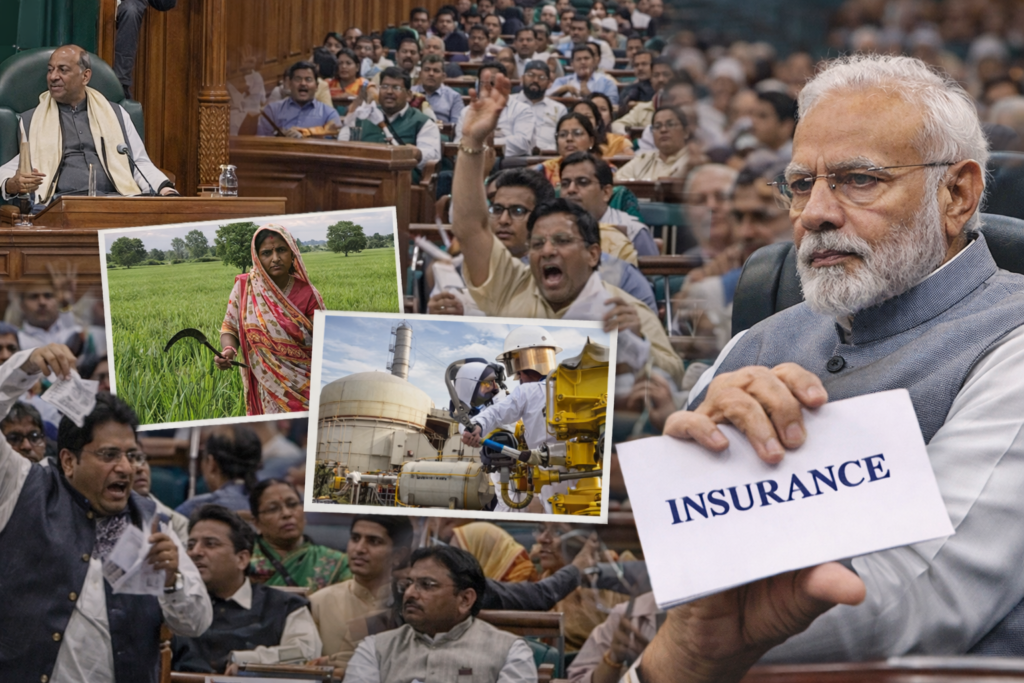
The Lok Sabha was adjourned sine die on Friday, formally bringing the 19-day Winter Session of Parliament to a close after the passage of several high-impact legislative measures. The session, which began on December 1, was marked by intense political confrontations, repeated protests by the opposition, and the clearance of major economic and governance reforms.
Speaker Om Birla, in his valedictory address, said the Lok Sabha recorded a productivity of 111 per cent during the 15 sittings, with members often extending proceedings late into the night to complete legislative business. Prime Minister Narendra Modi was present in the House when it was adjourned indefinitely.
Major Bills Passed
One of the most debated legislations during the session was the Viksit Bharat Guarantee for Rozgar and Ajeevika Mission (Gramin) Bill, also known as the VB-G RAM G Bill. The legislation replaces the two-decade-old MNREGA framework and promises up to 125 days of guaranteed employment for rural households. The Bill was passed amid loud opposition protests and disruptions in the House.
Another key reform was the passage of the Sustainable Harnessing and Advancement of Nuclear Energy for Transforming India (SHANTI) Bill, which opens India’s civil nuclear sector to private participation, marking a significant shift in the country’s tightly regulated nuclear policy.
The Lok Sabha also cleared amendments to insurance laws that raise the foreign direct investment (FDI) cap in the sector from 74 per cent to 100 per cent. The Sabka Bima Sabki Raksha (Amendment of Insurance Laws) Bill, 2025 was later passed by the Rajya Sabha through a voice vote.
Other Legislative Business
In addition to economic reforms, Parliament passed a Bill repealing 65 Amendment Acts and six principal laws that were deemed obsolete.
A proposed higher education reform law—the Viksit Bharat Shiksha Adhisthan Bill, 2025—was referred to a joint committee of both Houses for further scrutiny. The Bill aims to establish a new overarching higher education commission along with three separate councils for regulation, accreditation and academic standards.
The Securities Markets Code Bill was also introduced and sent to a department-related standing committee for detailed examination.
Political Flashpoints
Two debates dominated the political discourse during the session. One marked the 150th anniversary of “Vande Mataram,” while the other focused on election reforms. The latter triggered repeated disruptions after opposition parties demanded a discussion on the Election Commission’s Special Intensive Revision (SIR) of electoral rolls in 12 states and Union Territories.
The government maintained that Parliament could not debate the functioning of the Election Commission, agreeing instead to a general discussion on election reforms. Opposition parties accused the ruling BJP of undermining electoral integrity, allegations the government strongly rejected.
A scheduled debate on air pollution, which was to be initiated by Congress leader Priyanka Gandhi, did not take place.
What Lies Ahead
The Winter Session reflected the Modi government’s intent to push through an ambitious reform agenda covering employment, nuclear energy, insurance and regulatory frameworks. At the same time, it highlighted deep political divisions over electoral processes and institutional independence—issues that are likely to dominate parliamentary debates in the months ahead.
Originally published on 24×7-news.com.