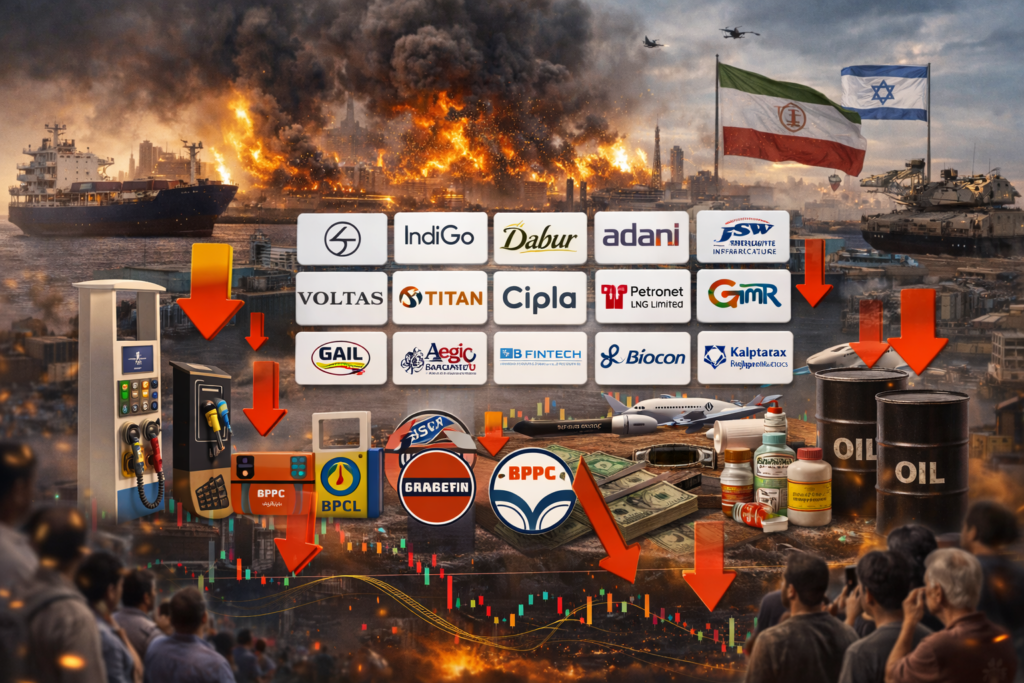
Escalating tensions in the Middle East have triggered fresh concerns for Indian investors, with more than 30 listed companies facing direct or indirect exposure to the region.
The Strait of Hormuz — a critical maritime chokepoint — handles nearly 20% of global oil trade and over 40% of India’s crude imports. Any disruption could significantly alter India’s economic outlook. Brent crude has already climbed above $80 per barrel, and analysts warn that prices could surge past $90 or even $100 in a prolonged conflict scenario.
Every $1 increase in crude prices adds roughly $2 billion to India’s annual import bill, intensifying pressure on inflation, fiscal balances, and corporate margins.
India’s Deep Middle East Linkages
India’s economic exposure to the region is substantial:
- 17% of India’s goods exports go to the Middle East
- 55% of crude oil imports originate from the region
- 38% of India’s remittances (around $45 billion in FY24) come from Indian workers in Gulf nations
- Nearly 31% of India’s EXIM cargo volumes are tied to MENA trade
Any supply disruption in the Strait of Hormuz could affect 10–13% of global crude supply and up to 15% of global LNG exports, amplifying volatility.
Oil Marketing Companies: Immediate Impact Zone
Oil Marketing Companies (OMCs) are the most vulnerable to rising crude prices.
For every $1 increase in Brent:
- Auto-fuel marketing margins fall by about ₹0.55 per litre
- Consolidated EBITDA could decline by 7–9%
HPCL is considered the most exposed due to its higher marketing leverage, followed by IOCL and BPCL. Sustained crude above $80 may force retail price hikes or excise duty cuts, impacting fiscal stability.
A $10 increase in crude could add 20–25 basis points to inflation if passed on to consumers.
Infrastructure & Capital Goods: Order Book Risks
Engineering and infrastructure firms have significant Middle East exposure:
- L&T: 37% of its order book tied to the region
- KEC International: 20% of order book exposure
- Kalpataru Projects: 11% regional exposure
Any slowdown in Gulf infrastructure spending or maritime disruptions could delay project execution and compress margins.
Other exposed names include Voltas, Thermax, Cummins India, and AIA Engineering — particularly due to freight cost escalation and export dependencies.
Aviation & Logistics: Double Hit from Fuel and Airspace
IndiGo is among the most exposed airlines, with 35–40% of its international capacity linked to the Middle East. Higher aviation turbine fuel (ATF) costs and airspace disruptions could impact profitability.
Airports and port operators also face risks:
- GMR Airports: Flight cancellations and rerouting risks
- JSW Infrastructure: Exposure through Fujairah liquid terminal
- Adani Ports: Possible decline in tanker and LNG volumes
- Aegis Logistics: LPG import cost pressures
Gas, Fertilisers & Energy
City gas distributors such as IGL, MGL, and Gujarat Gas may see rising LNG input costs.
Petronet LNG and GAIL could also face volume and pricing pressures.
Fertiliser companies may experience increased subsidy burdens if global urea prices spike. A 10% rise in urea prices could add ₹2,500 crore in subsidy costs.
Consumer, Pharma & Exporters
Several companies derive 5–10% or more revenue from the Middle East:
- Consumer: Dabur, Titan
- Pharma: Ajanta Pharma, Biocon, Cipla
- IT & Fintech: Newgen Software, PB Fintech
- Healthcare chains: 8–10% revenue from international patients
Auto exporters and tyre manufacturers face rising freight and input costs, while paints and tiles companies could struggle with limited pricing power.
Defence: The Outlier Beneficiary
While most sectors face headwinds, defence stocks appear positioned to benefit.
India’s defence spending rose 18% year-on-year in FY26, with continued double-digit growth expected. Companies such as BEL, HAL, and Data Patterns may gain from sustained geopolitical uncertainty and increased capital expenditure.
The Key Variable: Strait of Hormuz
The duration and severity of the conflict will determine market outcomes.
If oil flows through the Strait of Hormuz remain uninterrupted, volatility may ease. However, any prolonged blockade could significantly strain India’s macroeconomic stability and corporate earnings.
For investors, the question remains: is this a temporary dislocation — or the beginning of a deeper economic ripple effect?
Originally published on 24×7-news.com.