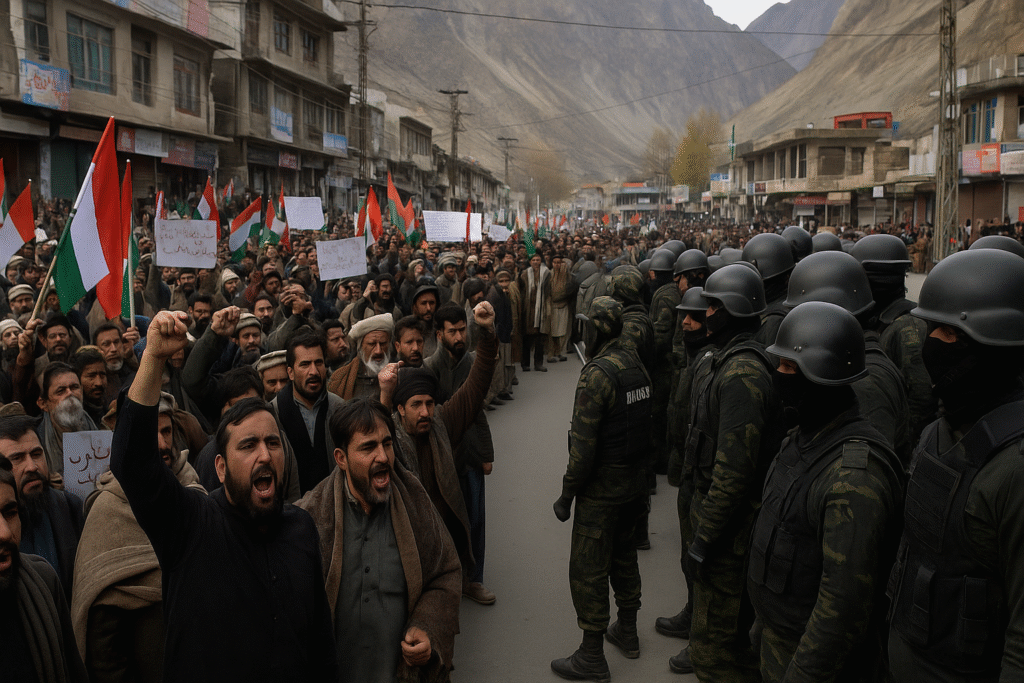
Gilgit-Baltistan (GB) has erupted in widespread protests as residents intensify their demonstrations against Pakistan’s policies on land acquisition, power shortages and long-standing political marginalisation. The unrest—one of the largest in recent years—has prompted Islamabad to respond with a heavy-handed security crackdown across multiple districts.
Protests Spread Across Key Regions
Demonstrations, road blockades and sit-ins have been reported from Gilgit, Skardu, Ghizer, Darel and Hunza. Trade unions, student bodies and civil society groups accuse the federal government of treating GB like a “colony,” arguing that development projects continue to undermine local rights.
Wheat Price Hike, Blackouts Fuel Public Anger
The latest round of protests was triggered by rising wheat prices, reduced subsidised supply and winter power cuts—some lasting nearly 20 hours a day. This has sparked frustration in a region rich in hydropower resources, where residents say Islamabad enjoys the benefits while they face darkness.
Land Seizures Without Compensation
Local communities are protesting land seizures for federal projects, including infrastructure linked to the China–Pakistan Economic Corridor (CPEC). Residents claim land is being taken without proper compensation or consultation, leaving them feeling sidelined in their own homeland.
Constitutional Vacuum at the Core of the Crisis
Gilgit-Baltistan remains outside the framework of Pakistan’s Constitution. The region has no representation in Pakistan’s National Assembly or Senate and is governed by federal orders, leaving major decisions in the hands of the Ministry of Kashmir Affairs.
Legal experts say this lack of constitutional rights allows sweeping control over land, administration and natural resources without accountability.
India maintains that Gilgit-Baltistan is legally part of the Union Territory of Jammu & Kashmir and is under Pakistan’s illegal occupation. It has repeatedly objected to CPEC projects passing through the region.
Crackdown: Arrests, Paramilitary Deployment, Media Pressure
As demonstrations grow, Pakistan has increased deployment of Rangers and paramilitary forces. Several activists have been arrested under strict security laws. Families allege intimidation, fabricated charges and enforced disappearances.
Journalists report being warned against covering protests or criticising federal policies.
Human-rights groups say the situation reflects decades of centralised rule that has kept GB politically voiceless while exploiting its strategic location.
A Strategic Region With Rising Resistance
Gilgit-Baltistan is a critical corridor for CPEC, connecting Pakistan to China via the Karakoram Highway. Analysts note that Islamabad’s priority remains securing strategic routes, not addressing local grievances.
Despite arrests and intimidation, protests continue to gather momentum. Locals say they want constitutional rights, ownership over land and representation—demands they argue Islamabad has long ignored.
With Pakistan already battling political and economic instability, unrest in GB adds yet another challenge. As of now, the government’s response remains force-focused, while people demand dignity, rights and a say in their future.
Originally published on 24×7-news.com.