Amid growing concerns over LPG cylinder shortages in several cities, the Ministry of Petroleum and Natural Gas has made electronic Know Your Customer (e-KYC) verification mandatory for domestic LPG consumers across the country. The move comes as global fuel supplies face disruption due to the ongoing conflict involving Iran, the United States, and Israel.
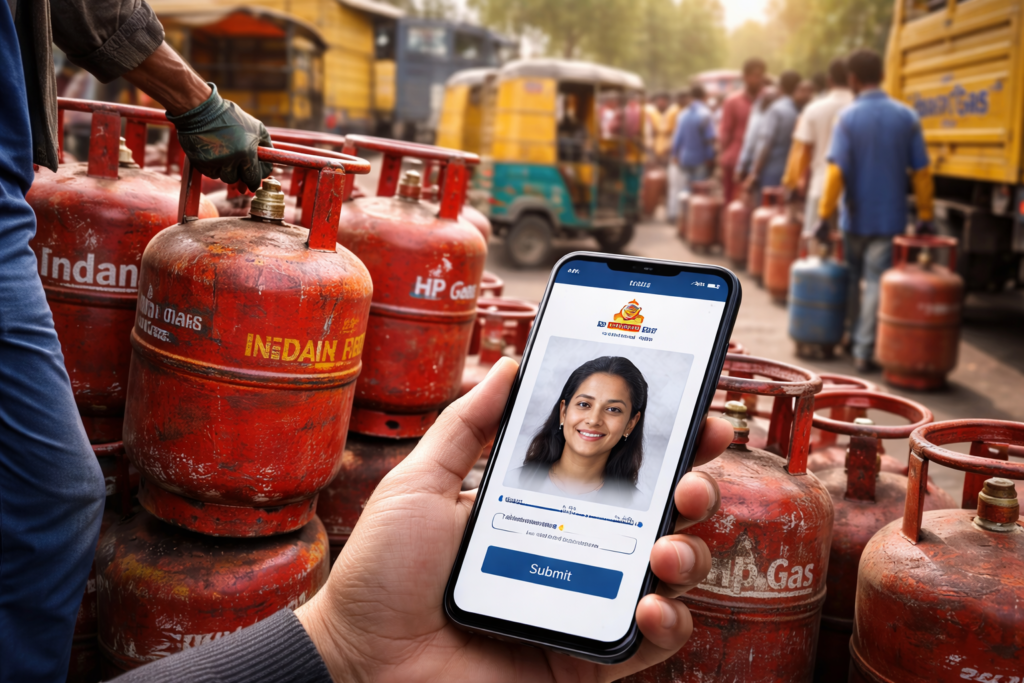
In a post on X (formerly Twitter), the ministry stated that all domestic LPG users must complete biometric Aadhaar authentication through the e-KYC process.
The ministry clarified that the procedure is free, simple, and can be completed within minutes using a smartphone.
How to Complete LPG e-KYC
Consumers can complete the verification process by following these steps:
- Visit the official website of your LPG provider or the Petroleum Ministry portal.
- Download the mobile application of your LPG company — Indane, Bharat Gas, or HP Gas.
- Install the Aadhaar FaceRD app on your smartphone.
- Log in to the LPG company app and select the e-KYC option.
- Use the Aadhaar FaceRD app to scan your face and complete biometric authentication.
- Submit the details to finish the e-KYC verification process.
Government Steps to Address LPG Supply Shortage
Alongside the e-KYC requirement, the government has introduced additional measures to stabilize LPG supplies.
A gazette notification issued on March 9 stated that domestically produced natural gas will now be prioritised for LPG manufacturing units. Previously, priority allocation of domestic natural gas was mainly given to the compressed natural gas (CNG) and piped natural gas (PNG) sectors.
Under the revised policy, LPG production has been added to the priority list, ensuring that the demand from LPG, CNG, and PNG sectors is met before natural gas is supplied to other industries.
Impact of the Middle East Conflict
The supply disruptions are largely linked to escalating tensions in West Asia, which have affected global energy routes.
One of the most critical choke points is the Strait of Hormuz, through which nearly 20% of the world’s seaborne oil and about one-third of global LNG shipments pass. Maritime traffic in the region has declined sharply amid the ongoing conflict, impacting global fuel supply chains.
Committee Formed to Review LPG Supply Issues
To further tackle the situation, the oil ministry has also formed a special committee to examine the sudden shortage of commercial LPG cylinders and recommend solutions to ensure smooth supply.
Officials say the government is closely monitoring the situation and taking steps to ensure that LPG availability remains stable for households and businesses despite global energy market disruptions.
Originally published on 24×7-news.com.