
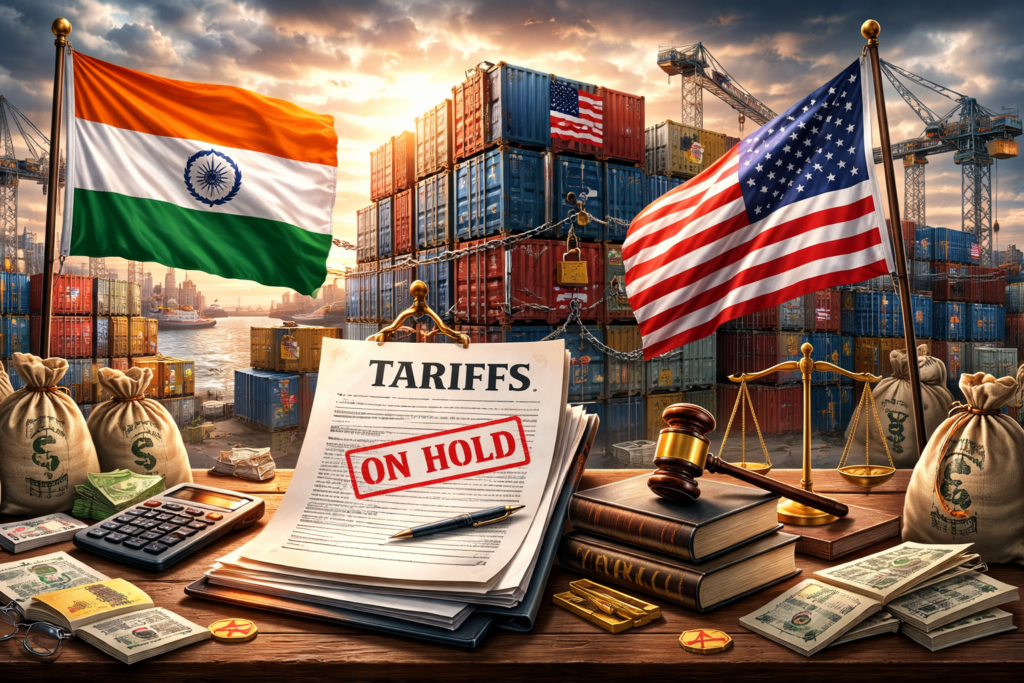
India has decided to adopt a cautious approach toward finalising its trade agreement with the United States, choosing to wait for clarity on Washington’s revised tariff framework following a landmark court ruling.
The proposed deal, which was expected to be signed earlier, has now been put on hold after the US Supreme Court invalidated tariffs imposed under the International Emergency Economic Powers Act. This decision has created uncertainty across global trade negotiations and forced several countries to reassess their agreements with the US.
According to government sources, India has not withdrawn from the deal but is awaiting a clearer tariff structure that ensures a competitive edge for Indian exports in the American market. Officials emphasised that India had only agreed to a preliminary framework and not a legally binding agreement, unlike some other countries.
Nations such as Malaysia, which had already formalised agreements, have declared their deals void following the ruling. Similarly, the European Union has paused its negotiations. India, however, remains in a flexible position, allowing it to reassess terms without legal complications.
A senior official noted that the primary focus for India is to secure favourable tariff conditions that protect its comparative advantage in key sectors. The US is currently working on establishing a new tariff mechanism, which will play a decisive role in determining the final agreement.
Earlier, reciprocal tariffs were part of the negotiation framework. However, these have now been scrapped following the court’s verdict. In their place, the US has introduced temporary tariffs under Section 122 of the Trade Act of 1974, imposing a 10% duty on select imports.
In addition to tariff restructuring, discussions between the two countries are expected to address other critical trade issues, including Section 301 tariffs, non-tariff barriers, and Section 232 measures. The US has already initiated investigations into sectors such as manufacturing and imports linked to forced labour, which could lead to new tariffs in the coming months.
Trade data highlights that India maintained a significant trade surplus of approximately $58 billion with the US in 2025. American authorities have also raised concerns about excess production capacity in sectors like textiles, solar modules, steel, petrochemicals, and automotive goods.
Despite these challenges, India has indicated its willingness to move forward with the agreement—provided the revised tariff structure aligns with its economic interests. Until then, both nations are expected to continue negotiations while monitoring how global trade dynamics evolve after the court ruling.
Originally published on 24×7-news.com.