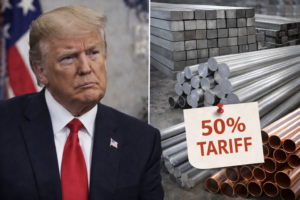
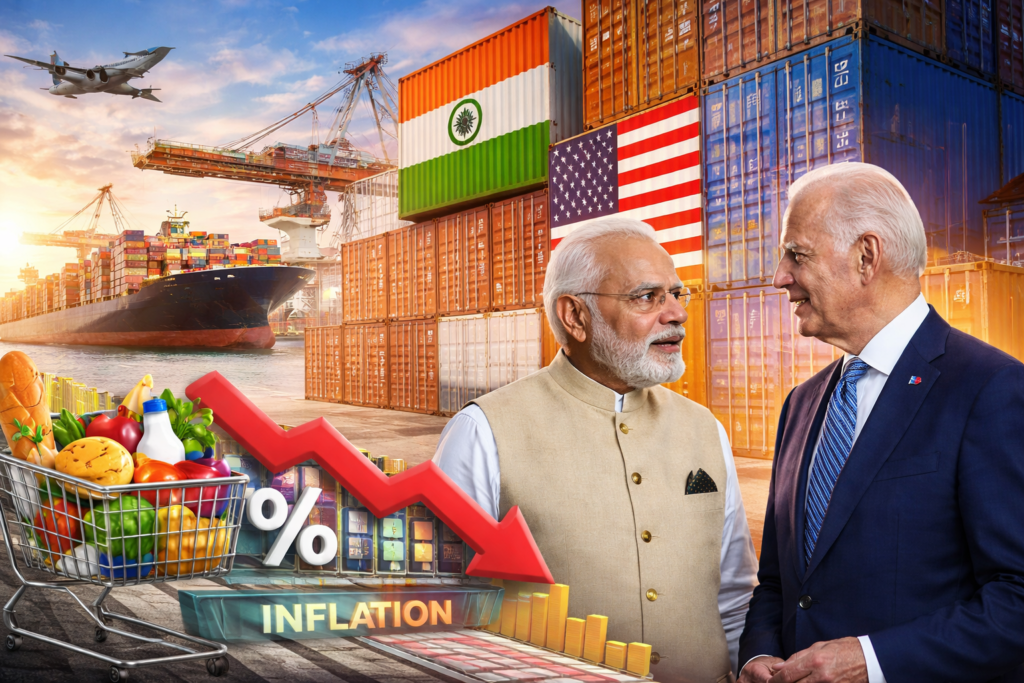
The recent recalibration of US tariffs on Indian exports is being viewed by many as a diplomatic development. However, a closer examination suggests that domestic economic pressures—particularly inflation—may have played a central role in shaping Washington’s approach.
Over the past few years, India has steadily expanded its global trade footprint, finalising agreements with partners such as the UK, Oman, and the European Union. The announcement of an interim trade arrangement between India and the United States marks another milestone. While early discussions aimed at a comprehensive, multi-sector trade pact, the decision to opt for an interim agreement appears to reflect broader economic realities.
Inflation Concerns in the United States
India has become a significant contributor to the US import ecosystem. During 2024–25, Indian exports to the United States reached approximately USD 86.51 billion, accounting for around 2.6% of total US imports. In specific sectors, India’s presence is even more pronounced—supplying over 9% of US textile and apparel imports, about 3% of housing-related consumer durables, and nearly 5% of food and beverage imports.
At the same time, the US imposed tariff increases across several of these sectors. Consumer Price Index (CPI) data for January 2025–26 indicated continued inflationary pressures: roughly 2.9% in food and beverages, 1.7% in textiles and apparel, and 3.9% in housing-related consumer durables. Notably, price movements accelerated following tariff notifications in August 2025. While inflation dynamics are shaped by multiple factors, the timing suggests trade measures may have contributed to cost pressures.
Forecasts from institutions such as RBC Economics indicate that core goods inflation in the US could approach 3%, levels reminiscent of earlier economic stress periods. Research from Federal Reserve bodies has increasingly linked tariff hikes to rising consumer prices, reinforcing concerns about the pass-through effects of trade barriers.
Domestic Impact and Policy Adjustments
The economic strain has not been limited to consumers. American farmers, impacted by retaliatory tariffs, required expanded federal support packages. Such measures underscore how trade restrictions can create domestic financial stress, prompting fiscal intervention.
Industrial production data for 2025 presents a mixed picture. Overall consumer goods production rose modestly, with food and beverage manufacturing showing slight gains. Household durable goods output also recorded incremental improvements. However, textiles and apparel production remained largely stagnant, indicating structural challenges that tariff protection alone could not resolve.
The broader takeaway is that while some industries experienced short-term gains, there was no widespread resurgence in US manufacturing capacity sufficient to offset rising consumer prices.
Economic Logic Behind the Tariff Reset
Against this backdrop, the decision to ease tariffs on select Indian exports—including textiles, engineering goods, and industrial components—appears aligned with anti-inflationary economic logic. Reducing import costs can help moderate price pressures and improve consumer affordability.
This does not diminish the geopolitical importance of Indo-US relations, which continue to be shaped by strategic partnerships, supply chain diversification, and Indo-Pacific cooperation. However, economic considerations—particularly inflation management—likely played a decisive role in shaping recent trade adjustments.
Trade agreements ultimately aim to expand consumer choice, stabilise prices, and strengthen economic resilience. In this context, the recalibration of tariffs may reflect pragmatic economic policymaking as much as diplomatic engagement.
Originally published on 24×7-news.com.