
Just over a week ago, India’s batting combination seemed untouchable. Despite visible concerns around their top order, the management resisted change, backing continuity over experimentation.
Captain Suryakumar Yadav had dismissed suggestions of bringing Sanju Samson into the XI during the group stage, choosing instead to trust Abhishek Sharma and Tilak Varma. India were unbeaten at the time, and the belief in their aggressive blueprint remained intact.
But everything shifted after a crushing 76-run defeat to South Africa exposed a structural flaw in India’s batting line-up.
The Problem: Too Many Left-Handers, Too Much Off-Spin
India’s strategy had revolved around Abhishek Sharma’s powerplay dominance, allowing the middle order to accelerate later. However, pairing him with Ishan Kishan created a top-heavy left-handed combination.
Opponents responded tactically, deploying off-spin early. Abhishek struggled for rhythm, and Tilak Varma, often arriving earlier than planned, looked restricted.
The imbalance became glaring in the defeat to South Africa — India’s heaviest loss in T20 World Cup history — pushing them into unfamiliar must-win territory.
The Tactical Reset: Samson Opens
Four days later in Chennai against Zimbabwe, the recalibration began.
Sanju Samson was promoted to open and took strike in the first over — a move that likely discouraged Zimbabwe from starting with off-spin. He set the tempo with a quick 25 off 15 balls.
The impact rippled through the order:
- Abhishek regained fluency with 55 off 30
- Ishan thrived at No. 3 with 38 off 24
- Tilak, now shifted to No. 6, smashed an unbeaten 44 off 16
The new structure restored balance and clarity.
The Eden Gardens Statement
The real statement came at Eden Gardens.
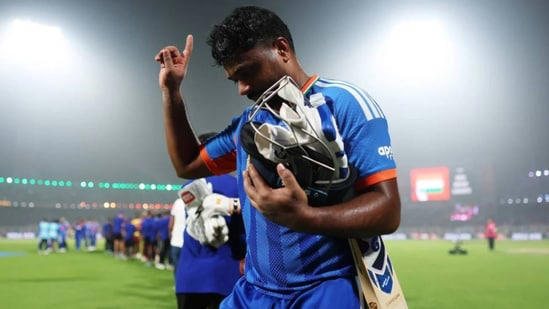
Opening the innings, Samson delivered a commanding 97 off 50 balls — 12 fours and four sixes — carrying his bat for the first time in his T20 career as an opener.
He didn’t even face a delivery in the first two overs. But once on strike, he dismantled the attack with classical shot-making rather than brute force.
Head coach Gautam Gambhir highlighted that composure:
“It was just normal cricketing shots. I never saw him muscling the ball. That is the kind of talent he has.”
In a tense chase, with early wickets down and visible anxiety in the dugout, Samson’s calmness steadied the innings. His partnership with Tilak Varma, who contributed a brisk 27 off 15, underlined the benefits of the reshuffled order.
A Rollercoaster Journey
Samson’s return to prominence has not been straightforward.
After three centuries in late 2024, he was India’s first-choice opener. A lean patch in 2025 saw him replaced by Shubman Gill and eventually dropped. During the 2024 T20 World Cup, he didn’t feature in a single match.
At times, he appeared on the fringes of the squad.
Yet when opportunity resurfaced, he responded with arguably the most consequential knock of his career — not merely in terms of runs, but impact.
Blueprint at the Right Time
As India approach the decisive stages of the tournament, the recalibrated batting order appears settled:
- Samson as the stabilising yet attacking opener
- Abhishek freed from early spin pressure
- Ishan positioned flexibly
- Tilak thriving in a finishing role
The shift has corrected structural weaknesses just as knockout pressure looms.
In tournaments defined by fine margins, timing often determines destiny. India may have stumbled into the Samson solution, but the blueprint now looks purposeful — and potentially title-defining.
Originally published on 24×7-news.com.