Fortuner Over Luxury Fleet: The Diplomatic Signal Behind PM Modi’s Drive With Putin
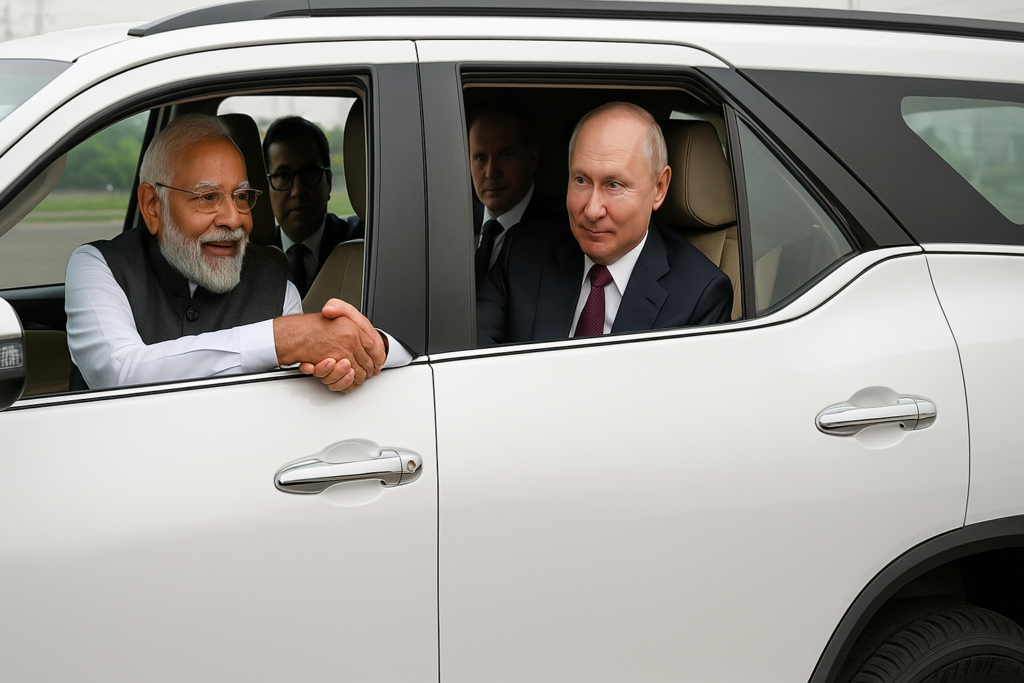
Russian President Vladimir Putin’s first visit to India in four years began with a remarkable break from standard protocol. Prime Minister Narendra Modi personally received him at the airport—an unusual gesture—followed by a warm exchange. But the moment that truly sparked national and global curiosity came shortly after, when both leaders chose to travel in a white Toyota Fortuner instead of the PM’s official Range Rover or the Mercedes-Maybach S650 Guard.
The surprising vehicle choice triggered widespread discussion, with analysts and social media users speculating whether the decision carried diplomatic symbolism.
Symbolic Messaging: A Subtle Nudge to the West?
Although no official explanation has been issued, geopolitical experts quoted by various media outlets suggest the move was intentional.
A prevailing theory is that using a Japanese-branded car instead of a European one sent a quiet geopolitical message, especially at a time when both India and Russia face criticism from Western nations over the Ukraine conflict.
Defence analyst Colonel Rohit Dev described it as “a message to the West,” noting that transporting Putin in a vehicle manufactured in countries supporting sanctions against Russia—like the UK (Range Rover) or Germany (Mercedes)—would have created uncomfortable optics.
One commentator put it plainly:
“A European car for Vladimir Putin would have raised eyebrows. A Japanese car avoided that narrative entirely.”
Make in India Appeal: A Strategic Nationalist Undertone
Another angle gaining traction is domestic symbolism. Many Toyota Fortuner models are manufactured in India, aligning with the Make in India vision and projecting economic self-reliance.
Observers also noted that a Fortuner Sigma 4 with a Maharashtra registration was used—highlighting a deliberate preference for a vehicle widely associated with Indian roads, government fleets, and rugged practicality.
A similar vehicle was used by Defence Minister Rajnath Singh during his engagement with Russian Defence Minister Andrei Belousov, strengthening the theory of a coordinated messaging strategy.
Practicality Over Optics: Security Sources Offer a Simpler Explanation
While symbolism dominated public conversation, government officials provided a far more functional reason.
Unlike Modi’s Range Rover, the Fortuner has a third seating row, allowing interpreters to be seated well in advance without disrupting security protocols. With two leaders and two interpreters travelling together, the Fortuner offered the most efficient seating layout.
“Range Rover does not have a third row,” a source explained. “The Fortuner met all logistical needs perfectly.”
Notably, Putin’s Aurus Senat and Modi’s Range Rover followed behind in convoy, but the Fortuner led—creating a powerful moment of shared space and symbolism.
A Small Gesture, A Loud Message
Whether motivated by geopolitics, nationalistic messaging, practicality—or a blend of all three—the choice of vehicle added an unexpected layer of diplomacy to Putin’s visit.
BJP spokesperson Shehzad Poonawalla summed up the intrigue on X, posting:
“Smart people will know why.”
In an era where optics matter as much as words, the leaders’ short drive in a Toyota Fortuner became one of the most discussed diplomatic signals of the visit.
Originally published on 24×7-news.com.