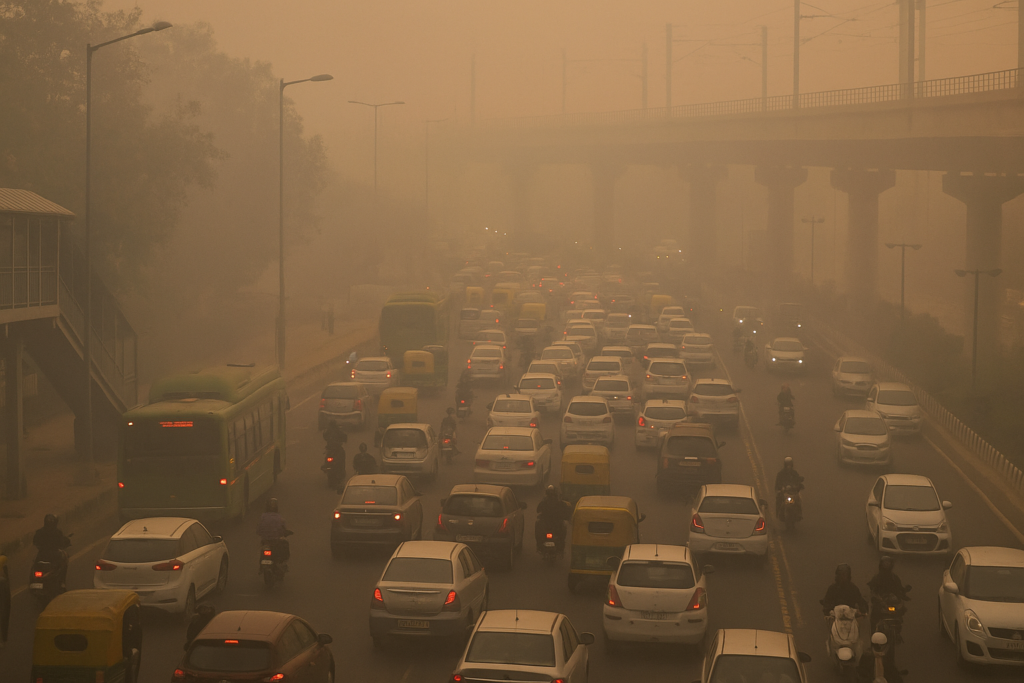
A major five-year scientific analysis has revealed that Delhi’s evening commute is the most damaging time of day for the lungs, with post-work travellers inhaling significantly higher levels of toxic particulate matter.
Researchers from the Netaji Subhas University of Technology and AARC Engineers and Consultants India found that:
- PM2.5 exposure is 40% higher during evening rush hours
- PM10 exposure is 23% higher compared to morning commutes
The study, one of the most detailed assessments of real-time pollution exposure in Delhi, highlights how regular traffic patterns, seasonal variations, and geography combine to create the world’s most dangerous urban air.
Delhi: Still the World’s Most Polluted Capital
According to IQAir’s 2023 report, nine of the world’s ten most polluted cities are in India, with Delhi topping the list once again. The capital frequently records extremely unhealthy AQI levels, far surpassing both Indian and WHO safety limits.
Fine particulate matter such as PM2.5 is linked to respiratory illnesses, cardiac disease, and even cancer.
Dr. Anurag Agarwal of Ashoka University said the study is significant because it connects pollution levels with respiratory deposition modelling, showing how deeply particles lodge inside the lungs.
How the Study Measured Exposure
Researchers analysed data from all 39 air quality monitoring stations in Delhi, covering January 2019 to December 2023. Using the ICRP respiratory model, the team estimated how much particulate matter actually deposits inside the lungs during various activities like sitting and walking.
Key findings include:
- Delhi’s PM levels exceed national and WHO standards on most days
- Peak PM10 reached 826.7 µg/m³, and PM2.5 touched 750.5 µg/m³ — over 40× higher than WHO guidelines
- Industrial and commercial zones reported the highest lung deposition rates
- Central Delhi showed relatively lower exposure due to better tree cover
A natural “experiment” during the COVID-19 lockdown showed that when traffic and industry were reduced, pollution levels dropped sharply, proving structural reforms can deliver immediate health benefits.
Evening Hours: The Most Dangerous Time of Day
The study shows a clear daily pattern: pollution surges in the late evening due to traffic congestion and stagnant winter wind conditions, delivering maximum particulate exposure to office-goers heading home.
Why Tiny Particles Are So Dangerous
Experts warn that:
- Particles >10 microns irritate the throat
- PM2.5 reaches the deepest part of the lungs
- Ultrafine particles enter the bloodstream and stay in the body for years
These particles can trigger asthma, bronchitis, lung damage, and systemic health issues.
What Delhi Residents Can Do
While large-scale action must come from the government, experts recommend personal protection strategies:
- Use air purifiers indoors
- Wear high-filtration masks outdoors
- Use portable air purifiers for long commutes
Reducing inhaled particles by 75–80% can dramatically lower daily health risks, even on the city’s worst pollution days.
Long-Term Fix Requires Government Action
Experts say only robust emissions control — from cleaner transportation, industrial regulation, dust management, and changes in agricultural practices — can address Delhi’s worsening air crisis.
The study’s conclusion is stark: Delhi’s daily commute has become a major health hazard, exposing millions to dangerous levels of pollution every evening.
Originally published on 24×7-news.com.