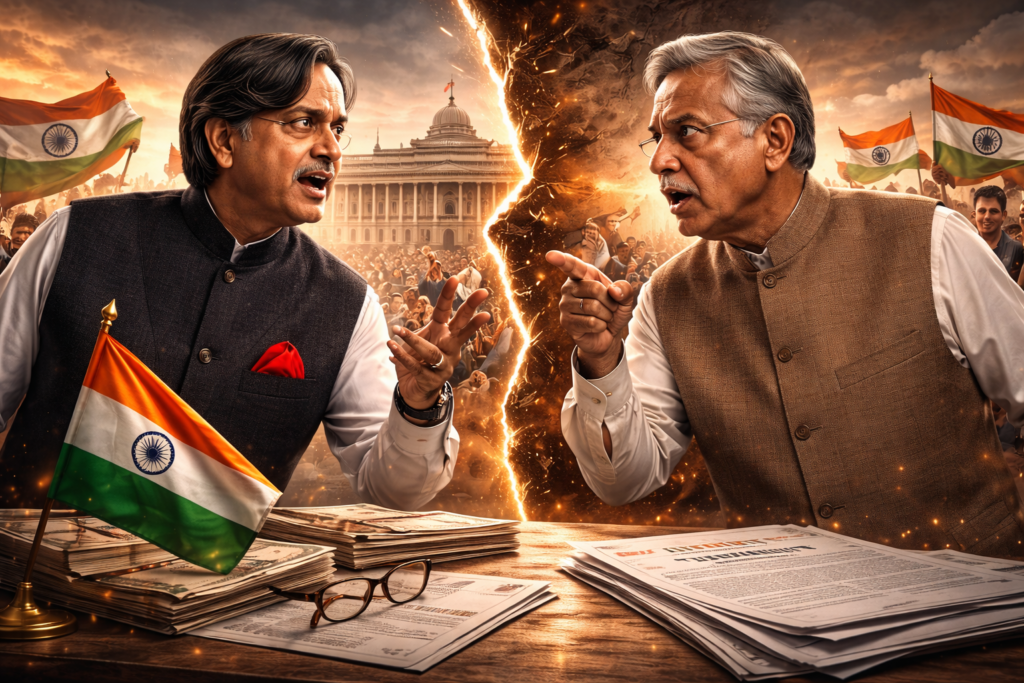
A public disagreement has surfaced within the Indian National Congress after senior leaders Shashi Tharoor and Mani Shankar Aiyar exchanged strongly worded open letters over their differing views on the ongoing conflict involving Iran, the United States and Israel.
The debate began after Tharoor’s remarks on the war during a television interview triggered criticism from Aiyar, revealing ideological differences within the party regarding international conflicts and India’s diplomatic stance.
Aiyar questions Tharoor’s stance
In an open letter published in Frontline, Aiyar said he was deeply surprised by Tharoor’s comments, which called for diplomacy and negotiations as a way to resolve the conflict.
Aiyar described the war as an “illegal and sinful” attack on Iran carried out by Israel with support from the United States and other Western countries.
He accused Tharoor of taking what he called an “unprincipled and transactional” approach to public policy and argued that such a perspective appeared to legitimise a global system driven by power politics.
According to Aiyar, Tharoor’s remarks suggested acceptance of a world order where stronger nations impose their will on weaker ones.
Reference to Tharoor’s Oxford speech
The veteran Congress leader also referred to Tharoor’s well-known Oxford Union speech, where he criticised colonialism and demanded reparations from Britain.
While praising that speech, Aiyar suggested that Tharoor’s current stance on the Iran conflict seemed inconsistent and hinted that it reflected a greater alignment with Western political positions.
He further compared Tharoor’s views to the pragmatic foreign policy approach often associated with External Affairs Minister S. Jaishankar.
Aiyar even speculated that Tharoor might be attempting to gain political goodwill with Prime Minister Narendra Modi, citing his international engagements and his role as chairman of a parliamentary standing committee.
Tharoor responds with ‘national interest’ argument
Tharoor responded through his own open letter published by NDTV, firmly rejecting Aiyar’s criticism.
Sharing the response on social media platform X, Tharoor said that accusations of “moral amnesia” were misplaced and suggested that others might be overlooking key facts in the debate.
He clarified that his perspective on global issues is guided primarily by India’s national interests, including security, economic stability and the country’s international standing.
Tharoor also emphasised that he had earlier described the war involving Iran as illegal in one of his recent opinion columns and reiterated his call for an immediate halt to hostilities.
Debate over India’s diplomatic legacy
In defending his position, Tharoor invoked the diplomatic legacy of India’s first Prime Minister Jawaharlal Nehru.
He argued that India’s foreign policy has evolved from strict non-alignment during the Cold War era to a more flexible multi-alignment strategy in today’s multipolar world.
However, he maintained that the core objective of India’s diplomacy remains unchanged — safeguarding national sovereignty while promoting global stability and justice.
Tharoor also highlighted practical considerations behind his call for diplomacy, including India’s economic interests and the importance of maintaining stability in the Strait of Hormuz, one of the world’s most crucial shipping routes for oil supplies.
The exchange between the two leaders has sparked wider debate within political circles, highlighting differing perspectives inside the Congress party on how India should respond to complex global conflicts.
Originally published on 24×7-news.com.