Toronto: The Canadian government has stood by remarks from a senior official indicating that India is no longer engaged in interference or targeted violence within Canada, despite criticism from pro-Khalistan groups and some political leaders.
According to a statement from the Prime Minister’s Office, Canada remains committed to addressing “any forms of transnational repression, transnational organised crime, and any contravention of the Criminal Code or rule of law on Canadian soil.” The statement also referenced the ongoing security and law enforcement dialogue between Ottawa and New Delhi.
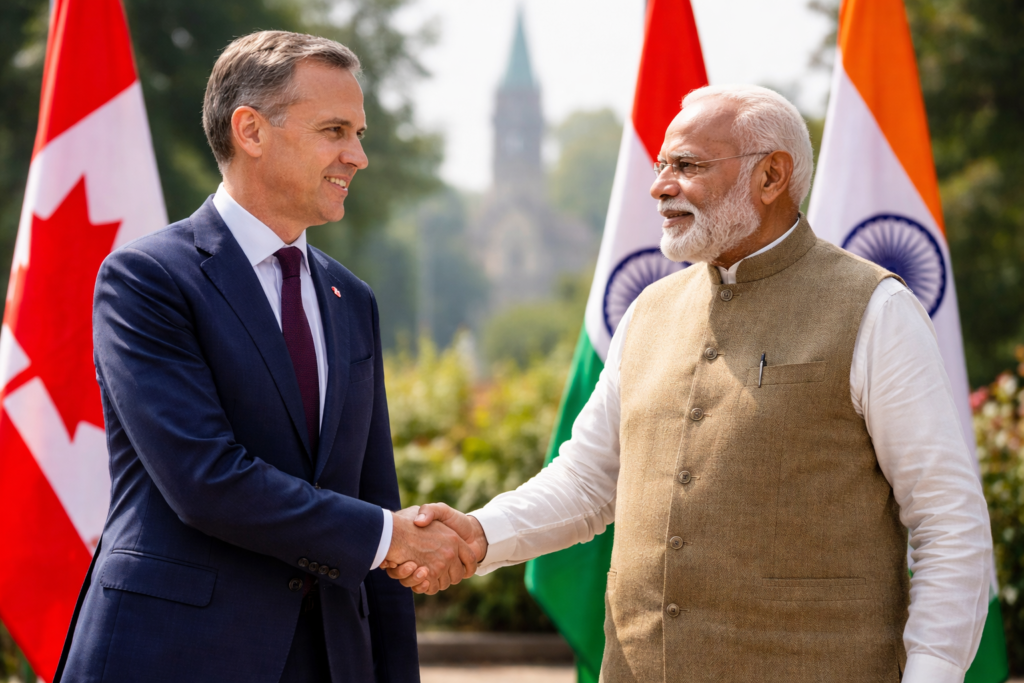
Canada’s Minister of Foreign Affairs, Anita Anand, while speaking to CBC News, did not contradict the earlier briefing by an unnamed official. She reiterated that issues related to public safety and national security would be discussed during Prime Minister Mark Carney’s visit to India. Anand is accompanying Carney along with three cabinet colleagues, with the Prime Minister scheduled to arrive in Mumbai on Friday.
Public Safety Minister Gary Anandsangaree acknowledged that “outstanding issues” remain between the two countries but stopped short of challenging the official’s assertion. “There’s still a lot more work to do, and we will do that work,” he said.
During the earlier background briefing, the unnamed official suggested that the trip to India would not be taking place if such alleged activities were ongoing. The official added that Canada maintains “mature, robust discussions” with India and has safeguards in place to prevent foreign interference.
However, Liberal MP Sukh Dhaliwal criticised the remarks, arguing they downplayed concerns about transnational repression. In a post on X, he called for the matter to be reviewed, stating that the comments appeared inconsistent with assessments made by Canadian agencies.
Community organisations also entered the debate. The Hindu Canadian Foundation questioned Dhaliwal’s stance, arguing that elected representatives should prioritise Canadian national interests and public responsibilities.
The issue of foreign interference had earlier surfaced during Canada’s 45th General Election. A government monitoring body, the Security and Intelligence Threats to Elections Task Force (SITE TF), had monitored potential interference by India but did not report any incidents in its findings. China and Russia, however, were cited for attempted interference activities.
Diplomatic engagement between the two countries has increased in recent months. National Security and Intelligence Adviser Nathalie Drouin visited New Delhi last year to initiate a security dialogue. Earlier this month, India’s National Security Adviser Ajit Doval travelled to Ottawa for discussions with Canadian counterparts.
The relationship between the two countries had deteriorated sharply in September 2023, when then Prime Minister Justin Trudeau stated in Parliament that there were “credible allegations” linking Indian agents to the killing of Hardeep Singh Nijjar in British Columbia. India strongly rejected the allegations, calling them “absurd” and politically motivated.
Relations began to stabilise after Mark Carney assumed office in March 2025. Following the Liberals’ return to power in the federal election, Carney invited Indian Prime Minister Narendra Modi to the G7 Leaders’ Summit. Both sides agreed to restore High Commissioners and resume negotiations toward a Comprehensive Economic Partnership Agreement.
The two leaders have met multiple times since then, including at the G20 Leaders’ Summit in Johannesburg. The upcoming visit marks their third bilateral engagement within ten months, signalling continued efforts to reset and stabilise diplomatic ties.
Despite renewed engagement, pro-Khalistan groups in Canada continue to express concerns, maintaining that issues of interference remain unresolved.
Originally published on 24×7-news.com.