As the Union government moves forward with plans to repeal the Mahatma Gandhi National Rural Employment Guarantee Scheme (MGNREGS) and replace it with a new rural employment framework, attention has turned to Prime Minister Narendra Modi’s earlier stance on the landmark programme during his first term in office.
MGNREGS, originally introduced as the National Rural Employment Guarantee Act (NREGA) by the UPA government in 2005, received bipartisan support at the time of its passage. Senior BJP leaders, including L K Advani and M Venkaiah Naidu, had endorsed the scheme’s objective of providing 100 days of guaranteed employment to rural households, while raising concerns primarily about transparency, efficiency and implementation.
However, after the NDA government assumed office in 2014, the scheme came under sharp scrutiny. Budgetary allocations were reduced in the 2014–15 revised estimates, triggering accusations from Opposition parties and activists that the government intended to dilute or dismantle the programme.
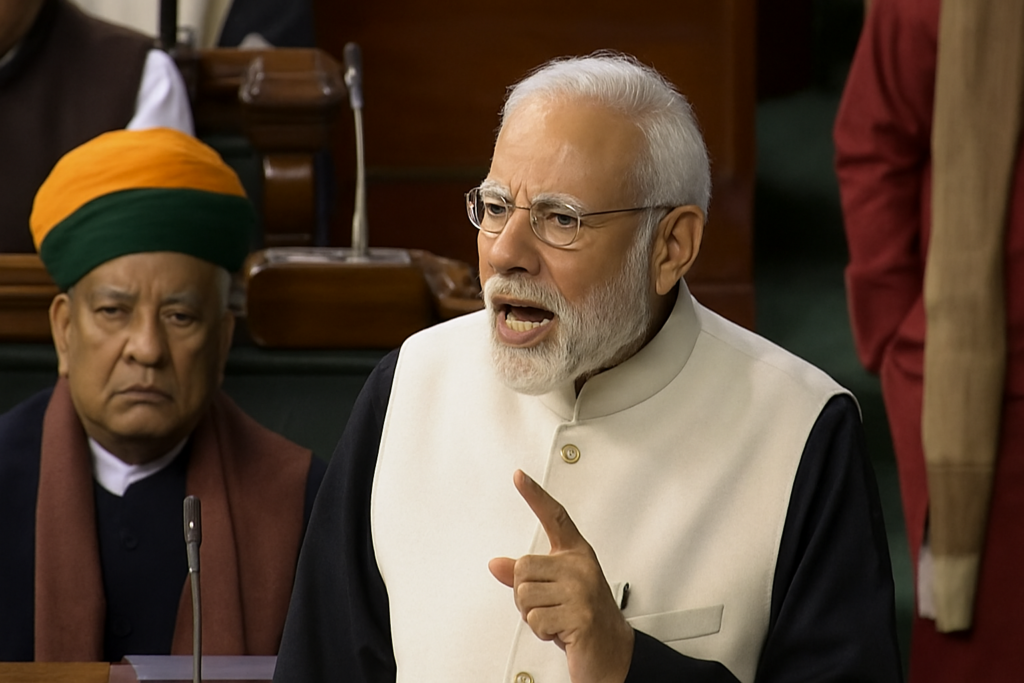
Amid mounting criticism, Prime Minister Modi addressed the issue in Parliament on February 28, 2015, categorically stating that his government would not scrap MGNREGS. Instead, he described the scheme as a “living memorial” of the UPA’s failures, arguing that it reflected decades of inadequate rural development that forced people into manual labour even after six decades of independence.
In a speech marked by political sarcasm, Modi said MGNREGS would continue “with pride” under his government and that necessary improvements would be made rather than weakening the scheme. He asserted that the programme would serve as evidence of the Congress-led UPA’s governance record.
The following day, then Finance Minister Arun Jaitley announced a modest increase in MGNREGS funding in the Union Budget, reaffirming the government’s commitment to employment generation despite fiscal constraints. Jaitley emphasised that national priorities such as agriculture, rural infrastructure, education, health and MGNREGS would continue to receive support.
A decade later, as the Centre proposes a new rural employment law aligned with its Viksit Bharat vision, Modi’s 2015 remarks are being revisited amid concerns that replacing MGNREGS marks a significant policy shift. The debate underscores the political and economic significance of the scheme, which has remained a cornerstone of rural welfare for nearly two decades.
Originally published on 24×7-news.com.