
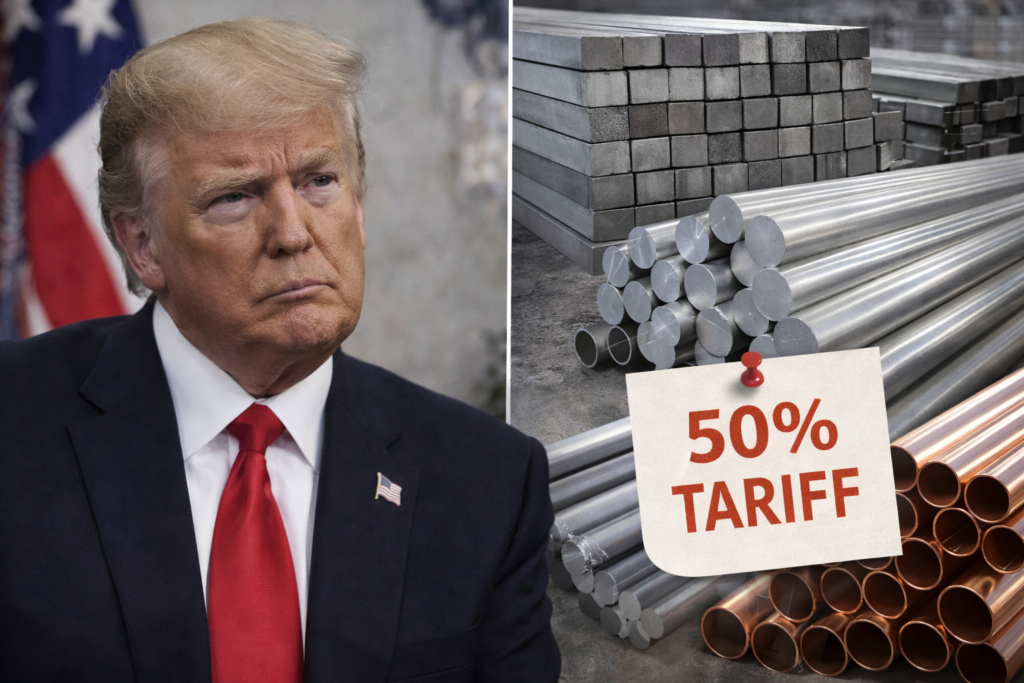
U.S. President Donald Trump has announced a revised framework for tariffs on steel, aluminum, and copper imports, maintaining a steep 50% duty on core metal commodities while introducing changes aimed at simplifying compliance and reducing loopholes.
The updated measures, issued under Section 232 of the Trade Act of 1974, will apply the 50% tariff based on the final price paid by U.S. buyers rather than declared import values. The move is intended to curb under-reporting practices, where some importers allegedly lowered declared values to reduce tariff liabilities.
Key Changes in the Tariff Structure
The revised policy introduces a more streamlined approach for derivative and metal-based products:
- Products containing less than 15% steel, aluminum, or copper by weight will no longer face the 50% tariff, easing the burden on goods with minimal metal usage.
- Metal-intensive industrial and electrical equipment will see tariffs reduced to 15% through 2027, aimed at supporting infrastructure and manufacturing growth.
- Items with more than 15% metal content will be subject to a flat 25% tariff on the total product value, simplifying calculations for importers.
- Goods manufactured abroad using entirely U.S.-origin metals will benefit from a reduced tariff rate of 10%.
Focus on Simplicity and Compliance
Officials stated that the changes are designed to make the tariff system more transparent and easier to implement. The previous structure required detailed calculations of metal content across a wide range of products, creating compliance challenges for businesses.
The revised approach replaces complex assessments with clearer thresholds and fixed rates, reducing administrative burdens while ensuring fairer enforcement.
Economic Impact and Industry Response
While the administration expects no major overall economic shift from the updated tariff regime, applying the 50% duty to full transaction values could increase tariff revenues. Industry feedback has reportedly been positive, particularly from sectors seeking clarity and reduced compliance complexity.
The policy reflects a broader effort to balance protection of domestic industries with practical adjustments that support manufacturing and infrastructure development in the United States.
Originally published on 24×7-news.com.