
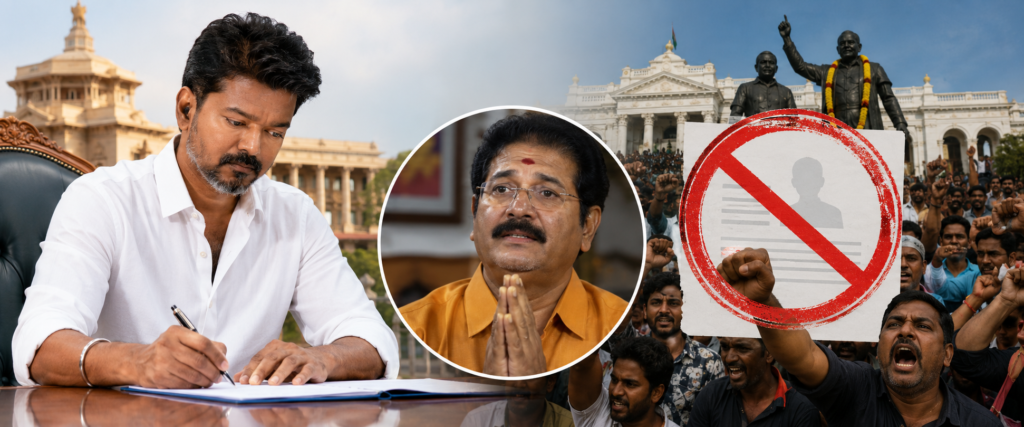
The Tamil Nadu government led by Vijay on Wednesday withdrew the appointment of astrologer Radhan Pandit as Officer on Special Duty (OSD) following widespread political criticism and controversy online.
The decision came just one day after the astrologer was appointed to the key government position, triggering objections from alliance partners, opposition leaders, and several political commentators.
The controversy unfolded on the same day Vijay successfully won the confidence motion in the 234-member Tamil Nadu Assembly, securing the support of 144 MLAs, comfortably above the required majority mark of 118.
Radhan Pandit, also known as Vettrivel, had reportedly predicted a major electoral victory for Vijay and had worked closely with the party leadership during the election campaign. Apart from being an astrologer, he also served as a spokesperson for the Tamilaga Vettri Kazhagam (TVK).
However, the appointment quickly drew criticism from several quarters, particularly from leaders advocating rational and scientific thinking in public administration.
Congress MP Sasikanth Senthil questioned the need for an astrologer to hold an official government position, while leaders from Left parties and alliance partners argued that the move contradicted the principles of secular governance and scientific temper.
D. Ravikumar described the appointment as unacceptable in a secular administration, while CPI(M) state secretary P. Shanmugam said the government had a responsibility to promote rational thought instead of legitimising superstition using public resources.
Leaders from the Viduthalai Chiruthaigal Katchi and Left parties also urged the government to focus on scientific and evidence-based governance.
Political reactions continued to intensify ahead of the Assembly floor test. Premalatha Vijayakanth criticised the move and stated that such appointments could send the wrong message to young voters who strongly supported Vijay’s party.
Radhan Pandit was previously known for having several high-profile political clients, including former Tamil Nadu Chief Minister J. Jayalalithaa. Reports suggest that some major political decisions during her tenure were taken after consultations with him, although their relationship reportedly weakened after one of his predictions related to a legal case proved incorrect.
Following mounting criticism, the Tamil Nadu government decided to revoke the appointment, bringing the brief controversy to an end.
Originally published on 24×7-news.com.