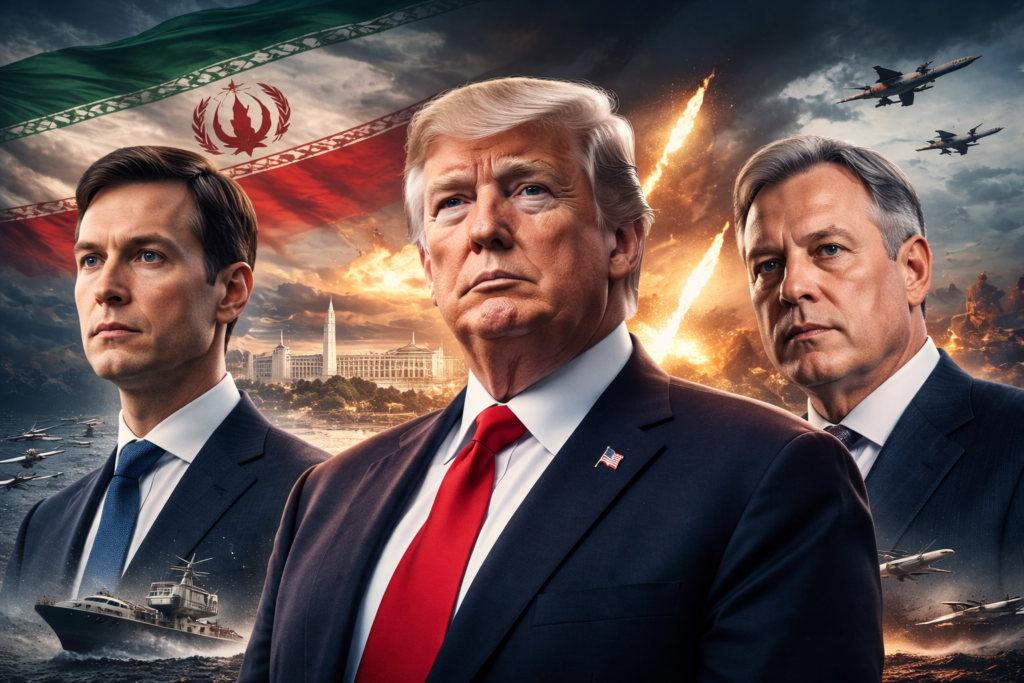
US President Donald Trump is yet to make a final decision on whether to authorise airstrikes against Iran, as diplomatic efforts continue ahead of a crucial round of negotiations in Geneva. According to reports, his decision will depend significantly on the assessment of senior envoys Jared Kushner and Steve Witkoff, who are leading the talks.
The administration is waiting to see whether Tehran is prepared to offer a credible proposal that addresses concerns about its nuclear programme. Officials expect Iran to submit a revised proposal before what has been described as a final round of negotiations scheduled for Thursday.
Sources familiar with the discussions indicate that Kushner and Witkoff’s judgment on whether Iran is negotiating in good faith will play a central role in shaping Trump’s next move.
Diplomacy or Military Action?
While negotiations remain ongoing, Trump has reportedly discussed several possible scenarios with his advisers. If diplomacy fails, he is considering limited airstrikes aimed at increasing pressure on Tehran. If that approach proves ineffective, broader military options — potentially targeting leadership structures — have also been debated, according to the report.
Witkoff has been involved in all high-level policy meetings on Iran and remains one of the president’s closest advisers on the issue.
Military Planning Underway
The president has received detailed briefings on military options, including discussions held in the White House Situation Room. Senior officials participating in the consultations include Vice-President JD Vance, Secretary of State Marco Rubio, CIA Director John Ratcliffe, Defence Secretary Pete Hegseth, Joint Chiefs Chair General Dan Caine, Chief of Staff Susie Wiles, and Director of National Intelligence Tulsi Gabbard.
Concerns have reportedly been raised within the administration about the effectiveness of potential strikes and the possibility of retaliation by Iran. Vice-President Vance is said to have questioned whether airstrikes would achieve their intended objectives.
Pentagon officials are also cautious about available missile defence resources. During last year’s strikes on Iranian nuclear facilities, the United States reportedly used 30 Patriot missiles to intercept retaliatory attacks — the largest such deployment in US history.
Iran’s Supreme Leader Ayatollah Ali Khamenei has warned that Tehran would respond forcefully to any US military action.
US Military Reinforcements in the Region
Amid the uncertainty, the US has increased its military presence in the Middle East. The aircraft carrier USS Gerald R. Ford is expected to arrive shortly, joining another carrier already stationed in the region. Additional deployments include F-35 and F-22 fighter jets, bombers, and aerial refuelling aircraft.
This build-up provides the administration with the option of launching a sustained air campaign if negotiations collapse.
Alternative Proposals Under Review
Even as military options are discussed, diplomatic alternatives remain under consideration. One proposal reportedly being examined would allow Iran limited nuclear enrichment strictly for civilian energy or medical research under strict monitoring.
Secretary of State Marco Rubio is expected to brief Israeli Prime Minister Benjamin Netanyahu on the outcome of the Geneva talks during his upcoming visit.
Decision Point Approaching
With talks entering what may be their final phase, Trump faces a significant choice between diplomacy and force. The assessments of Kushner and Witkoff regarding Iran’s seriousness in negotiations are expected to heavily influence the final decision.
For now, Washington appears to be keeping both options — negotiation and military action — firmly on the table.
Originally published on 24×7-news.com.