
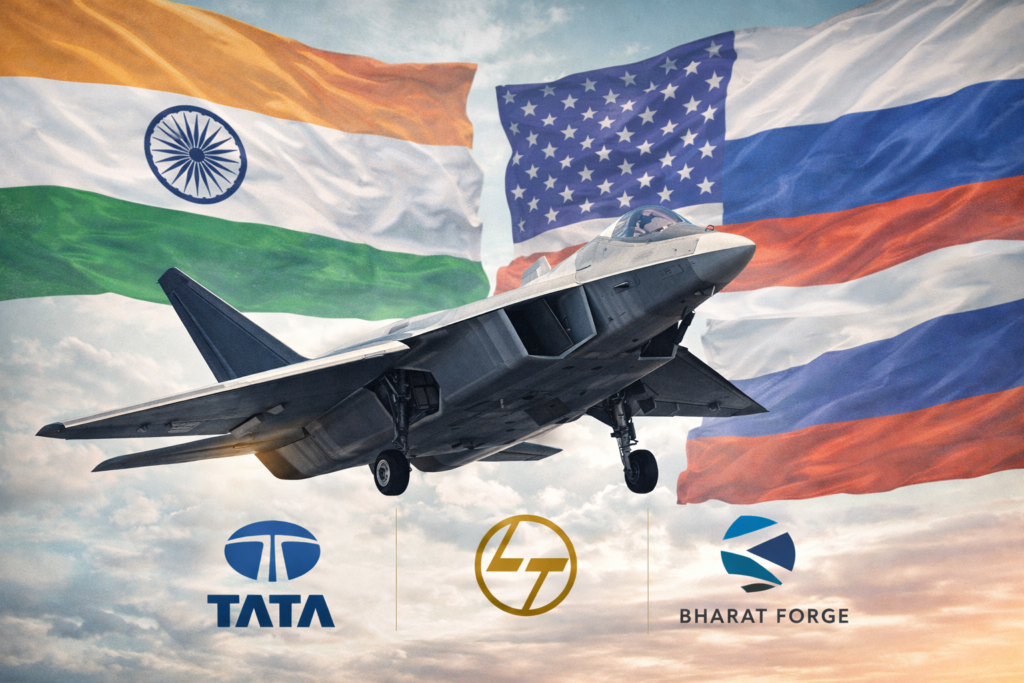
India’s ambitious plan to develop a homegrown fifth-generation stealth fighter jet has entered a crucial phase, with three private-sector contenders shortlisted to build prototypes for the Advanced Medium Combat Aircraft (AMCA) programme.
According to reports, Tata Advanced Systems Ltd, a Larsen & Toubro–Bharat Electronics Ltd consortium, and a Bharat Forge-led consortium have been selected for the prototype development stage after a competitive screening process conducted by the Defence Research and Development Organisation (DRDO).
Three Private Players in the Race
Initially, seven consortia had submitted bids, including Adani Defence and state-run Hindustan Aeronautics Ltd (HAL). After evaluation, only three private-sector groups progressed to the next phase.
The shortlisted entities are:
- Tata Advanced Systems Ltd (standalone bidder)
- Larsen & Toubro in partnership with Bharat Electronics Ltd (BEL)
- Bharat Forge in consortium with BEML Ltd and Data Patterns
The DRDO, through the Aeronautical Development Agency (ADA), had floated tenders in July 2025 inviting Indian industry partners to collaborate on the AMCA programme.
The selected companies are expected to receive government funding support to develop prototypes. Final manufacturing rights are likely to be awarded after successful development and evaluation.
What Is the AMCA?
The Advanced Medium Combat Aircraft (AMCA) is India’s indigenous fifth-generation stealth fighter project. It is designed as a single-seat, twin-engine aircraft featuring:
- Advanced stealth coatings
- Internal weapons bays to reduce radar visibility
- Cutting-edge avionics and sensor systems
The programme envisions production of more than 125 fighter jets, with induction into the Indian Air Force targeted around 2035.
If completed successfully, India would join a small group of nations operating fifth-generation fighters — currently limited to the United States (F-22, F-35), China (J-20), and Russia (Su-57).
HAL’s Bid Rejected
Hindustan Aeronautics Ltd (HAL), a key player in India’s defence manufacturing ecosystem, was not shortlisted at the screening stage. Sources indicate that the rejection was due to a documentation issue linked to a mandatory eligibility requirement rather than performance evaluation.
Although HAL may still compete later in the manufacturing phase, industry observers note that the entity responsible for prototype development is likely to hold a strategic advantage in securing final production contracts.
HAL Chairman and Managing Director DK Sunil had earlier stated that the company intended to participate in licence manufacturing of the AMCA even if it did not make the initial shortlist.
Parallel Defence Push: Rafale and P-8I Deals
In a separate development, the Defence Acquisition Council (DAC), chaired by Defence Minister Rajnath Singh, recently cleared a proposal to procure 114 Rafale fighter jets from France under an inter-governmental agreement for the Indian Air Force. Around 90 of these aircraft are expected to be manufactured in India.
The DAC also approved the acquisition of six additional P-8I maritime surveillance and anti-submarine warfare aircraft from the United States for the Indian Navy.
A Strategic Leap for India
The AMCA programme represents a significant step in India’s efforts to strengthen domestic defence manufacturing and reduce dependence on foreign suppliers. By involving private-sector heavyweights alongside DRDO, the government aims to accelerate indigenous capability in advanced aerospace technology.
If successful, the AMCA would place India among the elite group of nations capable of designing and producing fifth-generation stealth combat aircraft — a milestone in both technological and strategic terms.
Originally published on 24×7-news.com.