
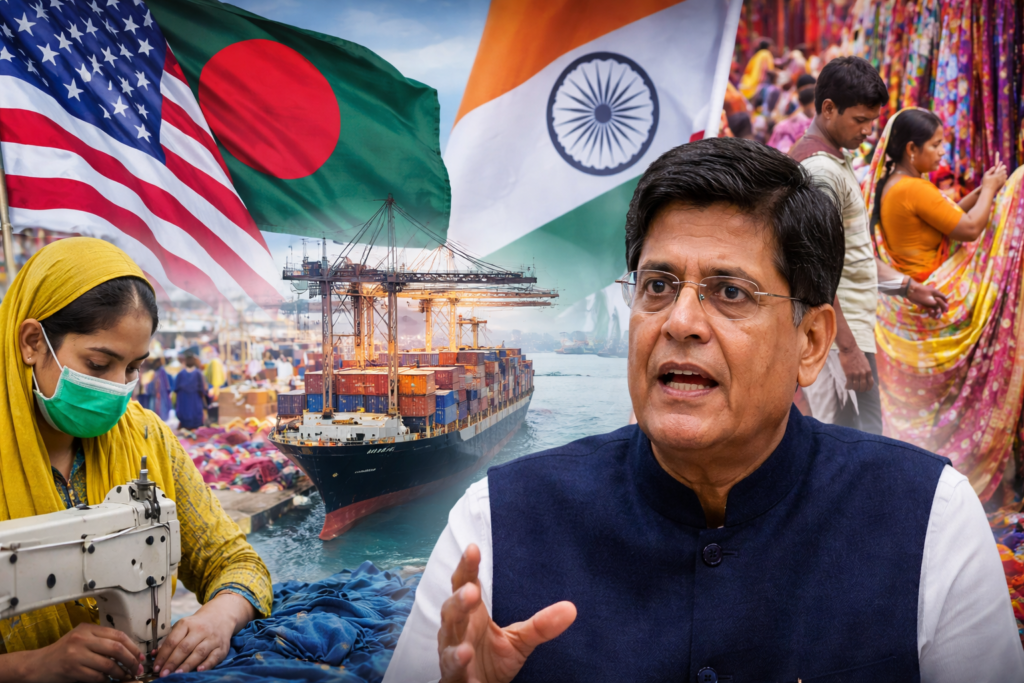
A newly signed trade agreement between the United States and Bangladesh, which allows zero-duty access for certain Bangladeshi textile and apparel exports, has sparked sharp criticism from opposition parties in India.
Under the agreement, textiles and garments produced in Bangladesh using US-origin cotton or man-made fibre will attract zero tariff in the American market. In contrast, Indian textile exports will continue to face an 18% duty under the recently concluded US–India trade arrangement.
Reacting to the development, Priyanka Chaturvedi of Shiv Sena (UBT) questioned the Indian government’s claims of having secured a favourable trade deal. In a post on X, she argued that India’s textile tariff has risen sharply from the earlier 3% level, while Bangladesh has now been granted duty-free access for select products.
She further pointed out that Bangladesh imports more US cotton than India, stating that New Delhi purchases around $200 million worth of American cotton annually, compared to Bangladesh’s $250 million. According to her, the new trade arrangement gives Bangladesh a clear competitive edge over Indian exporters.
The Indian National Congress also described the US–Bangladesh deal as detrimental to India’s textile sector. The party warned that major manufacturing hubs such as Tirupur, Surat and Panipat could suffer due to the tariff disadvantage in the US market. It also cautioned that India may lose Bangladesh as a key buyer of cotton and yarn.
The Congress said the agreement could have a double impact—hurting domestic cotton farmers and yarn spinners while making Indian garment exports less competitive globally. Bangladesh, a major importer of Indian cotton, may now shift sourcing towards the US to benefit from the zero-duty provision, the party alleged.
Details of the US–Bangladesh Trade Deal
Bangladesh’s interim chief Muhammad Yunus confirmed that the agreement allows certain apparel and textile goods manufactured with US materials to enter the American market without tariffs. He described the deal as a significant step in strengthening bilateral trade ties.
Commerce Secretary Mahbubur Rahman said the agreement was signed in Washington by Commerce Adviser Sheikh Bashir Uddin and US Trade Representative Jamieson Greer.
Apart from textiles, the deal includes commitments by Bangladesh to import US wheat, soybean and LNG, avoid imposing tariffs on e-commerce, align with US intellectual property standards, and support American proposals for reforming the World Trade Organisation.
According to Bangladesh’s Export Promotion Bureau, the US remains the country’s largest export destination.
The agreement comes at a politically sensitive time for Bangladesh, which is set to hold general elections on February 12, marking the end of the interim administration that assumed power following the fall of the Awami League government amid last year’s student-led unrest.
Originally published on 24×7-news.com.