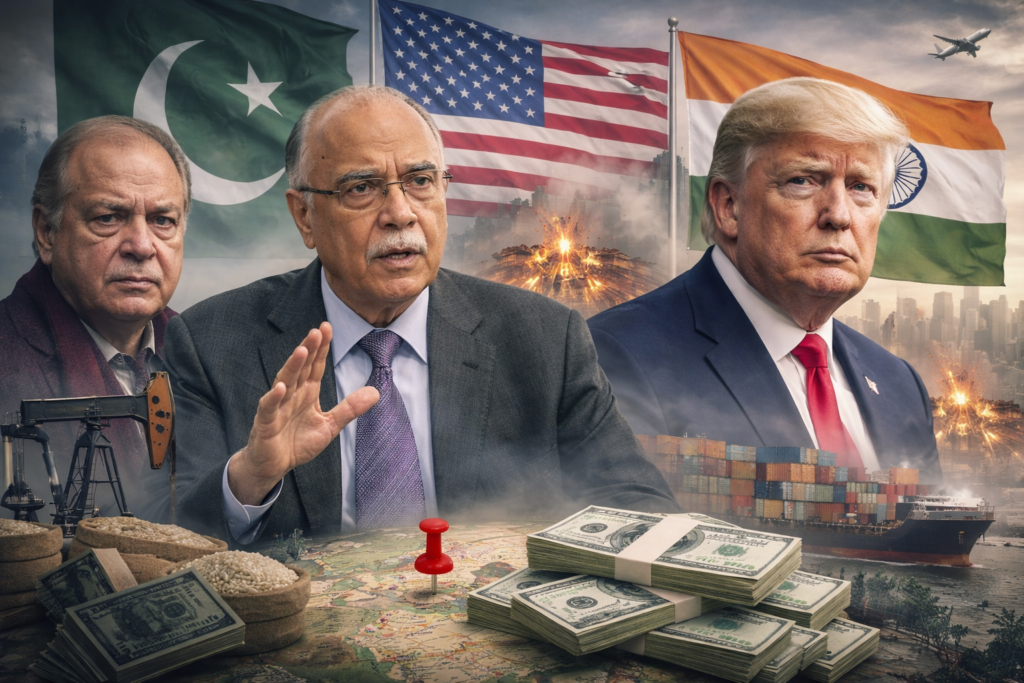
Pakistan’s diplomatic strategy toward the United States has come under renewed scrutiny following the recent India–US trade agreement, with political commentators and opposition figures questioning Islamabad’s reliance on symbolic outreach to former US President Donald Trump.
Since the announcement of the India–US trade deal last week, the Shehbaz Sharif government has faced mounting criticism from opposition leaders, journalists, and policy analysts. Several voices within Pakistan argue that the deal has exposed the limitations of Islamabad’s current engagement with Washington.
Opposition leaders from the Pakistan Tehreek-e-Insaf (PTI), along with journalists such as Asad Toor and Imran Riaz Khan, have accused Prime Minister Shehbaz Sharif and Army Chief Asim Munir of pursuing optics-driven diplomacy. They criticised what they described as an overreliance on White House dinners, public praise for Trump, Nobel Peace Prize endorsements, and mineral investment pitches that have yet to yield tangible outcomes.
Adding to the criticism, senior political commentator and close aide of Nawaz Sharif, Najam Sethi, expressed doubts over the sustainability of Pakistan’s approach toward Trump. Speaking on a recent programme, Sethi warned that Trump’s transactional style of politics poses long-term risks for Pakistan.
“I’ve been saying from the beginning that Donald Trump cannot be trusted,” Sethi said. “He may place demands that Pakistan finds difficult to meet, and if that happens, counter-pressure from Washington could follow. This is a scenario that may well unfold.”
Sethi’s remarks echo concerns raised by analysts in recent months, who have cautioned that Pakistan’s efforts to remain in Trump’s good books through symbolic gestures may ultimately backfire. According to these experts, a relationship built on flattery rather than substantive policy alignment risks becoming unstable.
While acknowledging that ties between Islamabad and the Trump administration are currently cordial, Sethi warned that changing geopolitical realities could strain relations. He pointed to developments in the Middle East and the strengthening of India–US ties as potential stress points for Pakistan.
Earlier reports had also highlighted similar concerns. Analysts have argued that Pakistan is engaging in a high-risk geopolitical strategy by overpromising deliverables to Trump—commitments that may be difficult to fulfil in the aftermath of recent regional security developments.
US-based critics have previously suggested that Pakistan’s civilian and military leadership may be appealing to Trump’s personal style of politics in hopes of securing favour. However, they warned that patience in Washington could wear thin if promised outcomes fail to materialise.
South Asia experts have also noted that Pakistan’s critical mineral reserves—often cited as a key bargaining chip—are largely located in insecure regions, making large-scale extraction and delivery uncertain. Such limitations, analysts say, could lead Washington to lose interest and shift its focus elsewhere.
In recent months, Islamabad’s outreach to the US has been marked largely by diplomatic symbolism and strong rhetoric, rather than concrete trade reforms or structural economic commitments. Critics argue that this approach contrasts sharply with India’s more institutional and policy-driven engagement with Washington.
As global trade and strategic alliances continue to evolve, analysts say Pakistan may need to recalibrate its US policy to prioritise substance over symbolism if it hopes to protect its long-term economic and geopolitical interests.
Originally published on 24×7-news.com.