
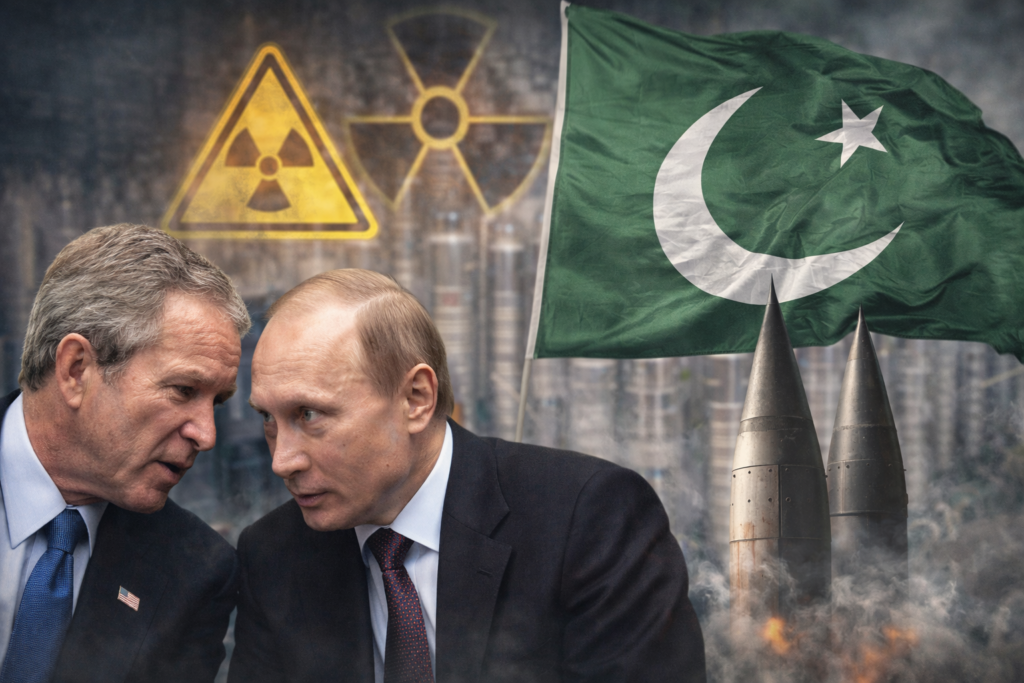
Newly declassified documents released by the National Security Archive have revealed that Pakistan’s nuclear programme was a major source of concern for both the United States and Russia during the early 2000s, with former leaders openly expressing alarm over proliferation risks.
The documents include verbatim transcripts of conversations between former US President George W Bush and Russian President Vladimir Putin, recorded between 2001 and 2008. Released following a Freedom of Information Act lawsuit, the records show that both leaders were deeply uneasy about Pakistan’s nuclear stability and its links to illicit proliferation networks.
Concerns Over Pakistan-Iran Nuclear Links
In a 2005 Oval Office meeting, Putin raised concerns about evidence indicating that uranium of Pakistani origin had been found in Iranian centrifuges, suggesting continued cooperation between Pakistan and Iran despite international scrutiny.
“But it’s not clear what the labs have, where they are. Cooperation with Pakistan still exists,” Putin told Bush, according to the transcripts.
Bush responded by acknowledging US pressure on then Pakistani military ruler Pervez Musharraf, saying Washington had repeatedly raised concerns over nuclear transfers to Iran and North Korea. He also expressed frustration over Pakistan’s lack of transparency regarding the interrogation of nuclear scientist A Q Khan, the architect of Pakistan’s nuclear programme.
“I keep reminding Musharraf of that. Either he’s getting nothing, or he’s not being forthcoming,” Bush said.
At one point, Putin remarked, “It makes me nervous,” referring to the Pakistani-origin uranium, to which Bush replied, “It makes us nervous, too.”
Early Warnings on Pakistan’s Political Stability
The declassified material also includes an earlier exchange from a 2001 meeting in Slovenia, where Putin described Pakistan as “just a junta with nuclear weapons” and criticised the lack of Western pressure despite the absence of democratic governance.
“I am concerned about Pakistan. It is just a junta with nuclear weapons. It is no democracy,” Putin said, urging greater international discussion on the issue.
Both leaders shared concerns about Pakistan’s internal political instability, military control over nuclear assets, and the risk of sensitive technology falling into the wrong hands.
AQ Khan Network and Global Proliferation
The transcripts underscore longstanding international anxiety over the AQ Khan network, which supplied nuclear technology and know-how to countries including Iran, North Korea, and Libya. The documents reinforce assessments that Pakistan’s nuclear programme posed not only regional but global security risks.
India Reiterates Long-Standing Concerns
The revelations come amid renewed criticism of Pakistan’s nuclear conduct. Last month, India responded sharply to reports citing former US President Donald Trump, who claimed Pakistan had carried out secret nuclear tests.
India’s Ministry of External Affairs spokesperson Randhir Jaiswal said such allegations were consistent with Pakistan’s historical record of clandestine nuclear activity and proliferation.
“Clandestine and illegal nuclear activities are in keeping with Pakistan’s history, centred around decades of smuggling, export control violations and the AQ Khan network,” Jaiswal said, adding that India has repeatedly flagged these concerns to the international community.
Originally published on 24×7-news.com.